
WLC - Rogers City, MI
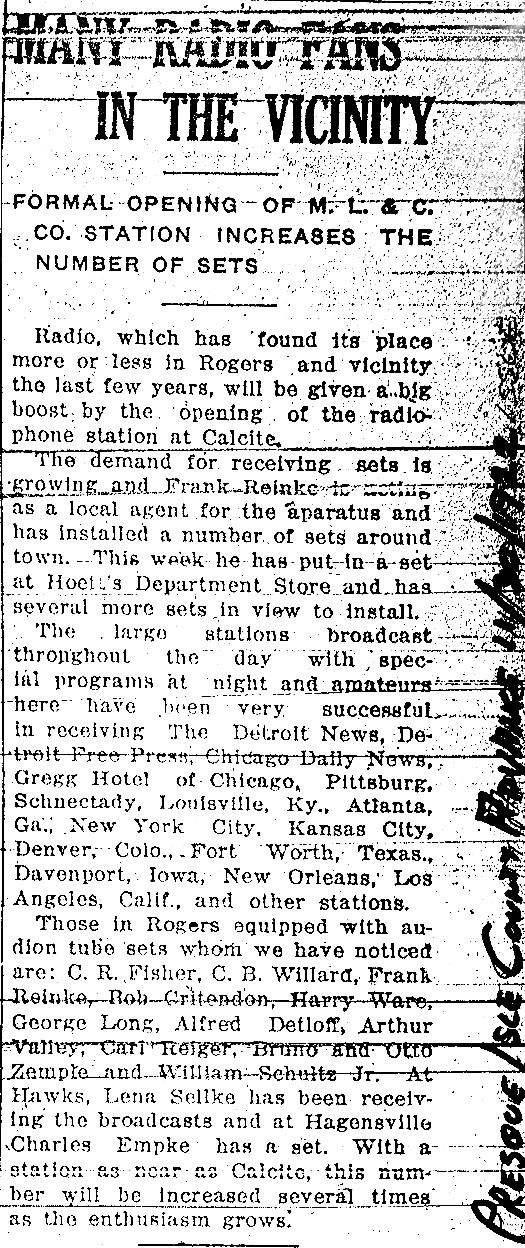
WLC originally came on the air in 1922 as private low-frequency spark-emission marine shore station WCAF. The station was planned by C. R. Fisher, Chief Electrical Engineer, and was put into operation by Robert F. Crittendon who remained with the station until 1962. In 1923 the station was re-licensed as a public station WHT providing service to all ships. In late 1924 the call letters were changed to WLC for "World Limestone Center." The first vacuum tube transmitter was installed late in 1922. Barry Heinzel, KB8DSL supplied this 11-30-1922 newspaper clipping. showing that there were some eager radio listeners in the Rogers City area at the time.
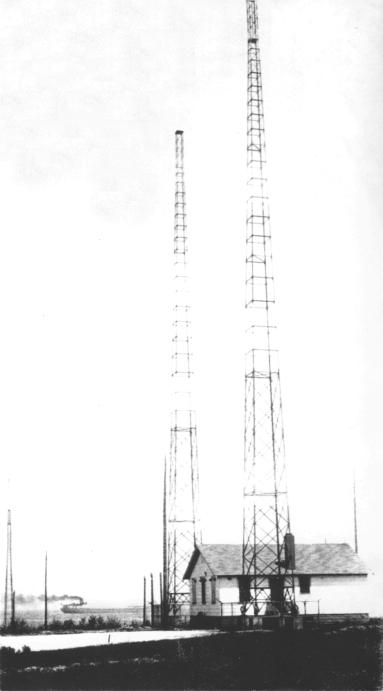 WLC - Ca. 1947 - Unknown Source - Click on the image for a view showing the towers at their full height. |
 |
|---|---|
The first ship-to-shore radio- telephone operation on the Great Lakes was pioneered by WLC in the 1922-24 period. However, the Great Lakes freighter & bulk-carrier owners were not ready for radiotelephone, and WLC reverted to exclusively CW operation until January 16, 1941 when ownership of radiotelephone station WHC Mackinac Island, MI was transferred from Thorne Donnelley to The Central Radio Telegraph Co. and relocated at Rogers City. See the full story from the FCC records.
In 1932
a license was granted for the
station to operate a radiotelegraph transmitter on HF. The operation
was very successful in communicating with Buffalo, Cleveland, Chicago
and Duluth, as well as with ships who were also licensed to work on the
high frequencies. WLF was the assigned call. On March 2, 1943
the
FCC renewed the coastal telegraph and marine relay license of WLF.
Radiotelephone frequency allocations above
3 MHz were approved by the FCC during the fiscal year that ended June
30, 1941, and radiotelephone privileges were added to the WLF license
that year. Sometime (after
1947?) the licensing was unified under the WLC
call.
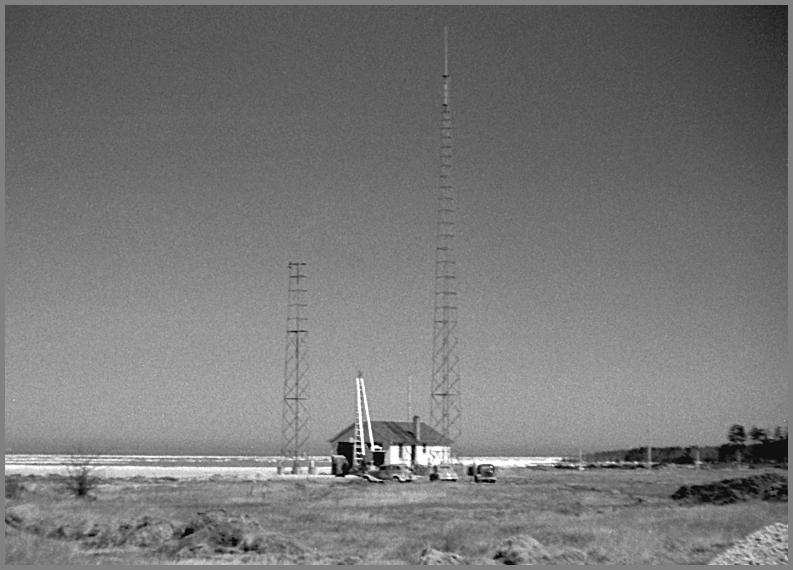 WLC's final home under construction with the left
tower only partly complete. It was taken on April 9, 1941 by
a
Rogers City amateur photographer, 18 year-old Charles L.
Heinzel . Thanks to his brother Barry for sending it. |
Between
1930 and 1941 the station
was moved several times before settling in at it's final site just on
the edge of Calcite Harbor as shown in the photo on the left and on the
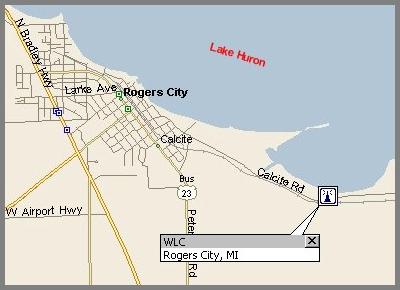
map above. The 1941 Rogers City telephone directory lists,
"Central Radio Telegraph Co. - 170 Woodward Ave. ----#459"
The June 30, 1941 FCC Annual Report states that the Coastal-Harbor station at Mackinac Island was moved to Rogers City, but curiously there is no mention of this in the rather extensive WLC history article that Station Manager, Robert Crittendon wrote in 1947. It is very fortunate that Randy Martens, the last operator of WLC, has a copy of this article and furnished it (and much other WLC material/photos) to us. It appears that the article was for a magazine but the publication is unknown. Some material on this page and several of the older photographs are from this article, and it's a "must-read" for those interested in more detail about WLC's history. The Historical Collections of the Great Lakes at Bowling Green State University has some information on the early years of the station. Unfortunately, information on the web-site about the station is minimal and the main part of the page is devoted to listing the contents of 22 boxes of WLC daily log-books from 1923 to 1930. |
|---|---|
WLC is shown on all of the AT&T maps. See the Map Index page.
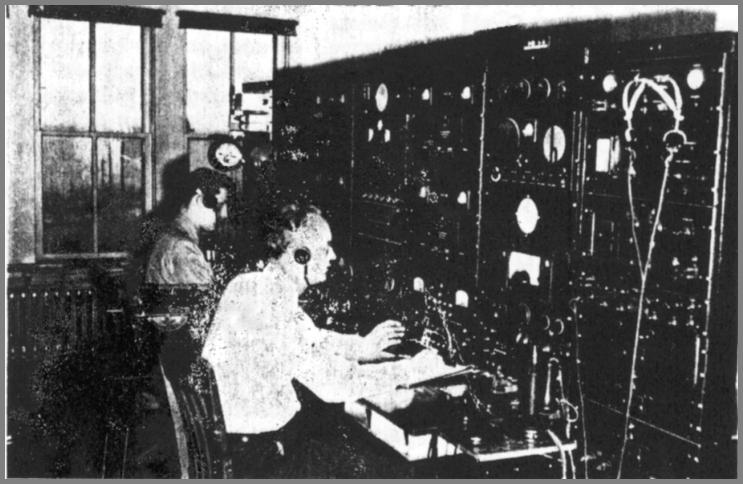 WLC 1947 Operating Positions. |
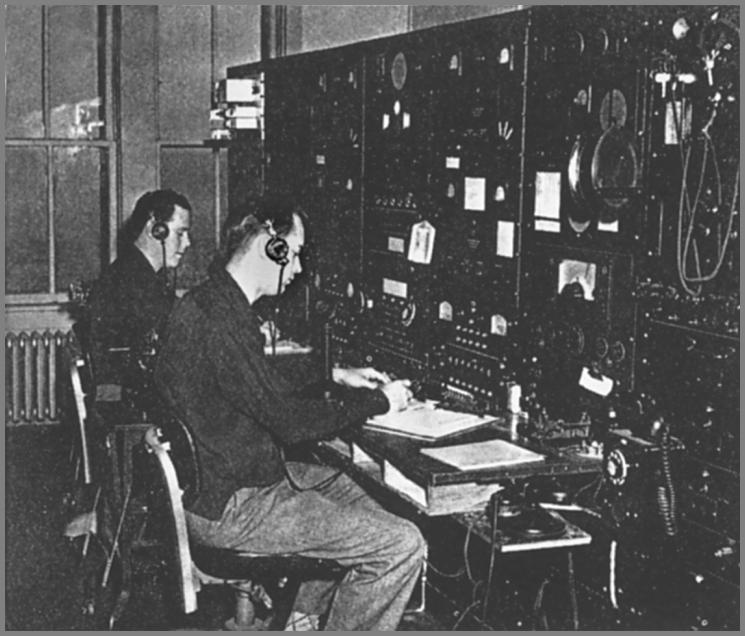
|
|---|---|
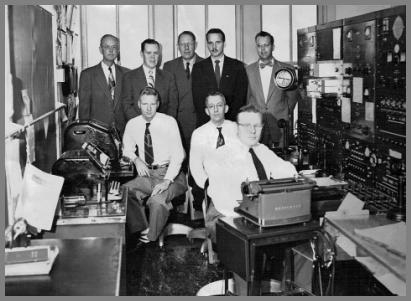 The WLC Crew in 1953 L to R Rear: Bob Crittendon - Joe Hassett - Jay Seymour - Tom Curtis - Jack Fanning --- Foreground: Daryl Stath ? - Frank Sager - Harvey Peltz - Click on the image for larger, and more, 1953 Crew photos |
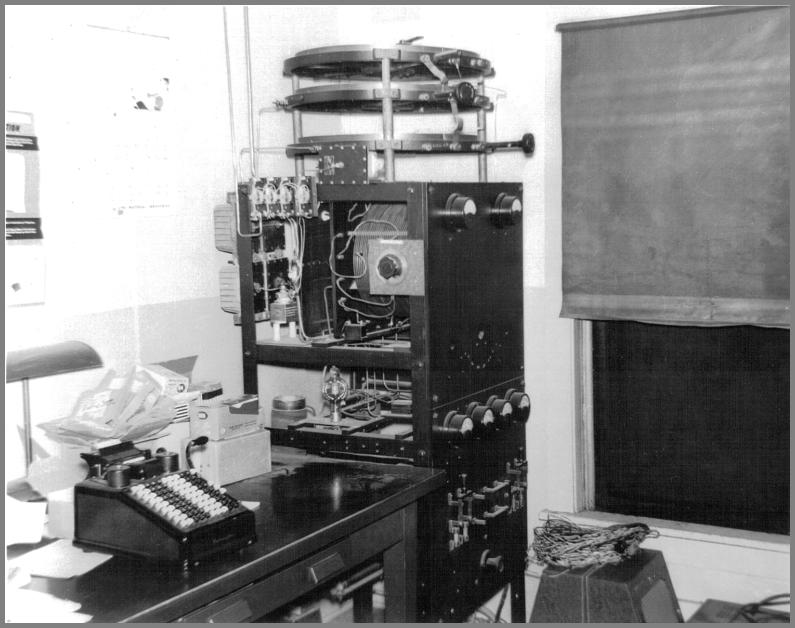 WLC's 1953 LF CW Transmitter -
500KHz & 476? KHz |
|---|---|
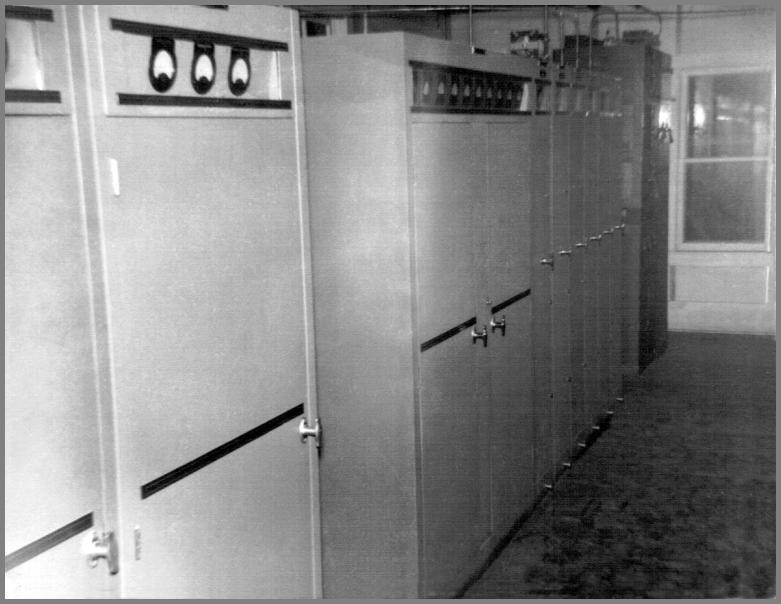 Two banks of WLC Wilcox AM Transmitters - 1953 |
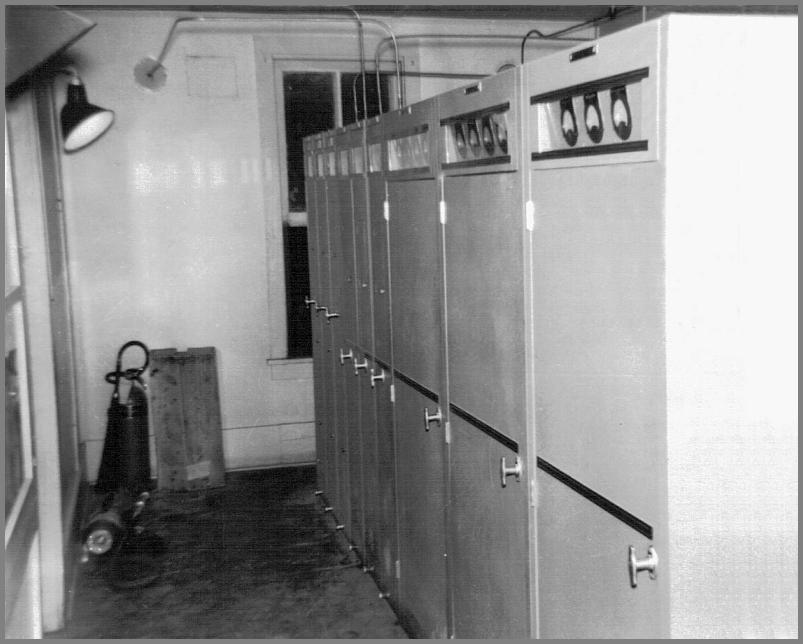
|
|---|---|
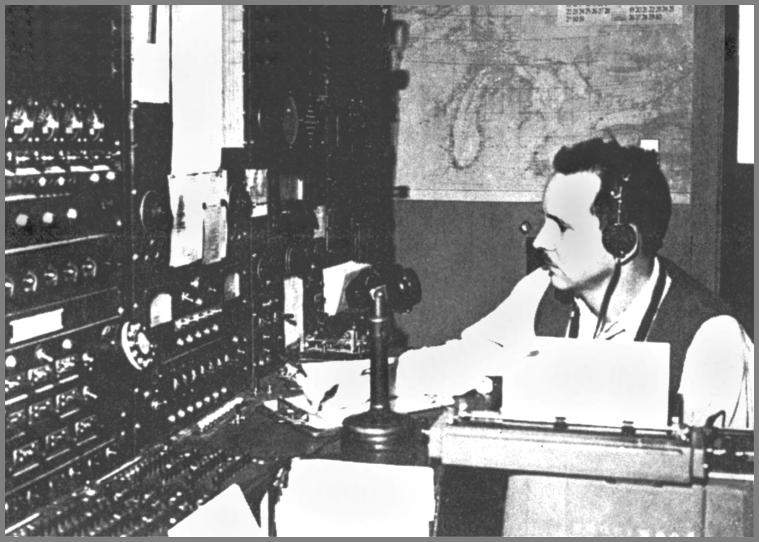 Tom Curtis Operating WLC in 1958 - This photo accompanied a short article about the Mayday message sent by the sinking Carl D. Bradley. Unknown Source |
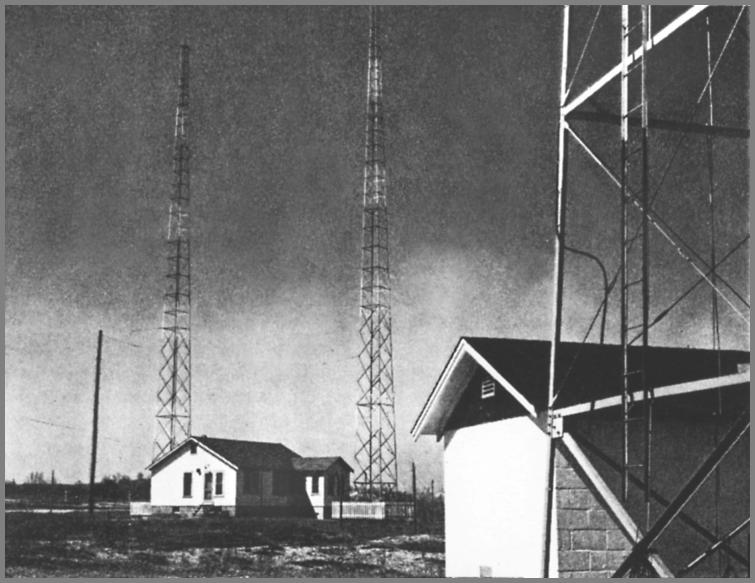 WLC Main Building & Towers - Taken from the Base of the Channel 26 Tower - Probably taken in the 1970s Unknown Source |
|---|---|
This WLC
article
in the Presque Isle County Advance-Centennial Issue of July 30. 1971 is
the source of the two photos below. It repeats some of the
information in Robert Crittendon's WLC history article
mentioned above, but it also provides an abbreviated update to
1971.
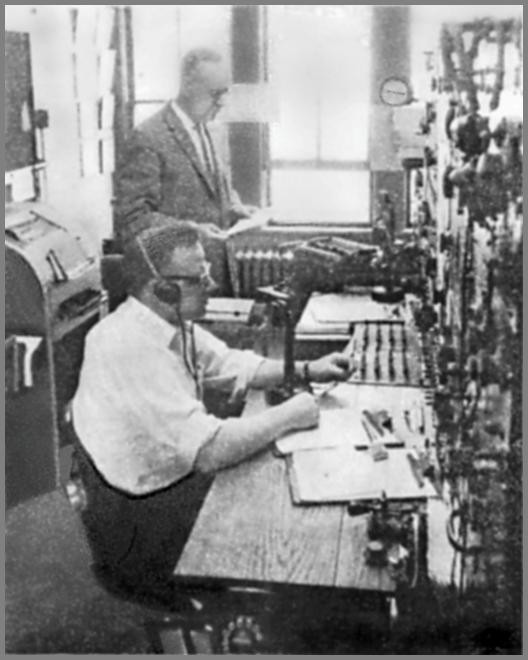 Here's how Central Radio's Communication center looked a number of years back (1950s or 60s ) when Bob Crittendon, (standing) was manager. Harvey Peltz is the operator in the foreground. Both of these photos are from the PRESQUE ISLE COUNTY ADVANCE-CENTENNIAL ISSUE-July 30. 1971 |
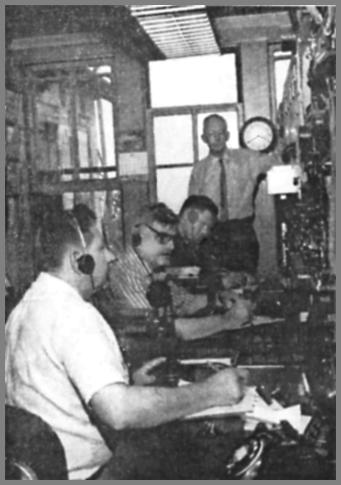 Frank Sager, (standing) oversees the operations as manager of Central Radio Telegraph. Others in the photo (L to R) are operators William Pettee, Robert Mix and Ray Heimberger.Click for Bigger Version with expanded caption |
|---|---|
Tom Curtis reports that CW was still in use when he left in Sept. of 1962 and no VHF FM facilities had been installed at that time.
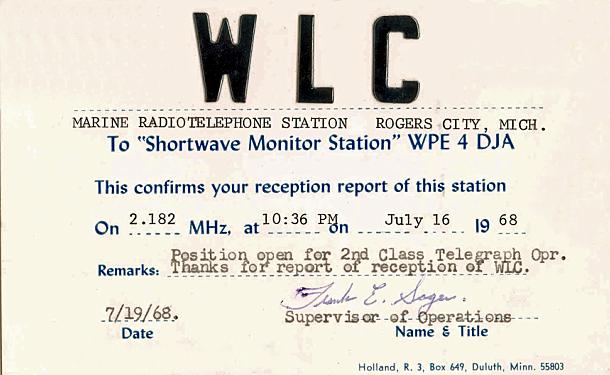
Other than this 1968 WLC QSL card , contributed by Jeff Yates, we have little information about the station from about 1960 to the mid 1980s so the next images are from the mid/late 1990s, the last years of WLC's operation. Information about about the stations history during the 50s to 80s time period is missing. Some of the questions are: When was CW discontinued? When was the first VHF-FM station installed? When was the VHF-FM station network put in service?
Ian Marsh, G4EXD, provided these 1978 frequency listings.
 WLC Main Operating Position in 1997 Photo by Joe Olig |
 Another 1997 WLC Operating Position View - Photo by Joe Olig |
|---|---|
Randall (Randy) Martens was hired at WLC in 1980, became a supervisor in 1982 and replaced the retiring Harvey Peltz as manager in 1987. This hort article details the 1991 purchase of the station (from United States Steel when they were breaking up the corporation) by Martens and a partner, Susan Rutledge, USS's WLC bookkeeper. During the 1980s SITOR service was started. This copy of the draft material for a 1985 WLC Brochure gives details on the operation of the station at that time with emphasis on the advantages of the new SITOR service.
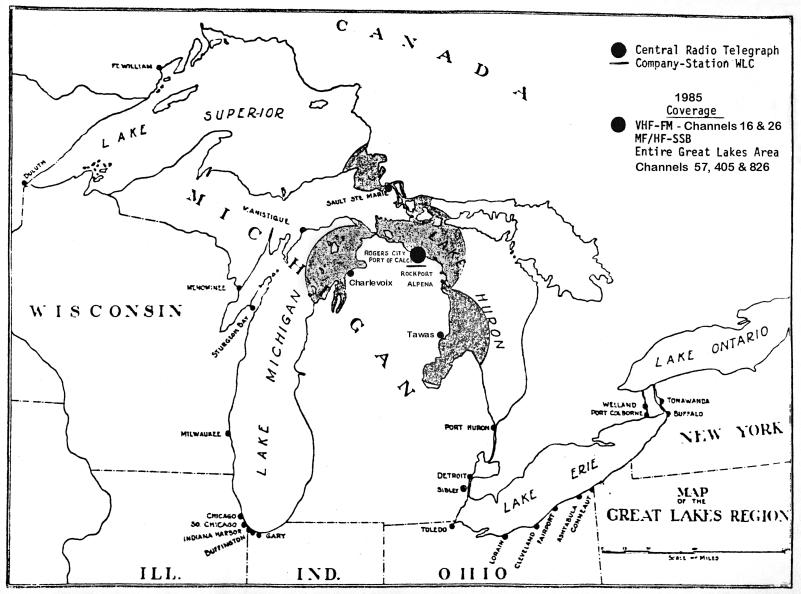
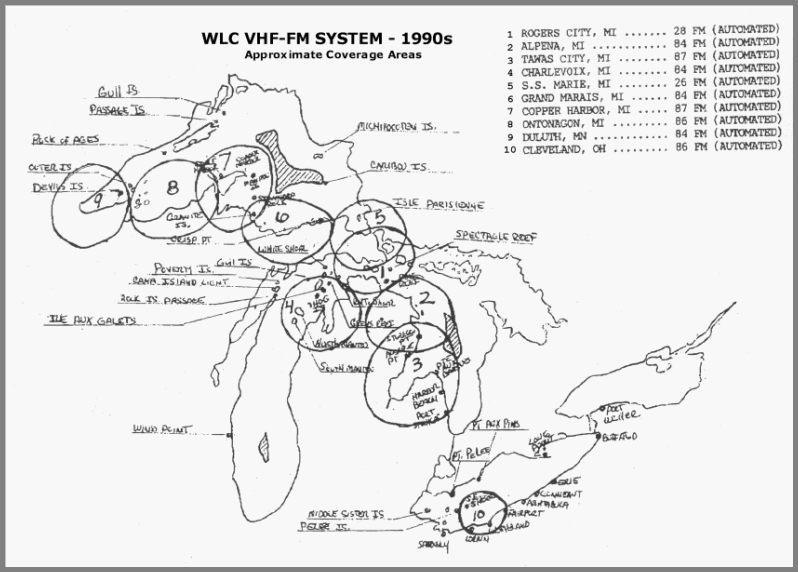
About 1990 the 4-station VHF-FM network was expanded via WLC's purchase of some of the former Lorain Electronics VHF system stations that WJG-Maritel had purchased, operated and then shut down in 1990 for lack of traffic. The following FM stations were purchased from WJG-Maritel: Duluth, Ontonagon, Copper Harbor, Grand Marais, Pickford, Alpena, Harbor Beach, and Chicago. After running these a few years the ones that had the least amount of traffic were dropped, By the time of the closure in 1997 Pickford, Harbor Beach, and Chicago had been closed. Here are maps of the VHF-FM system in 1985 and in the mid 1990s.
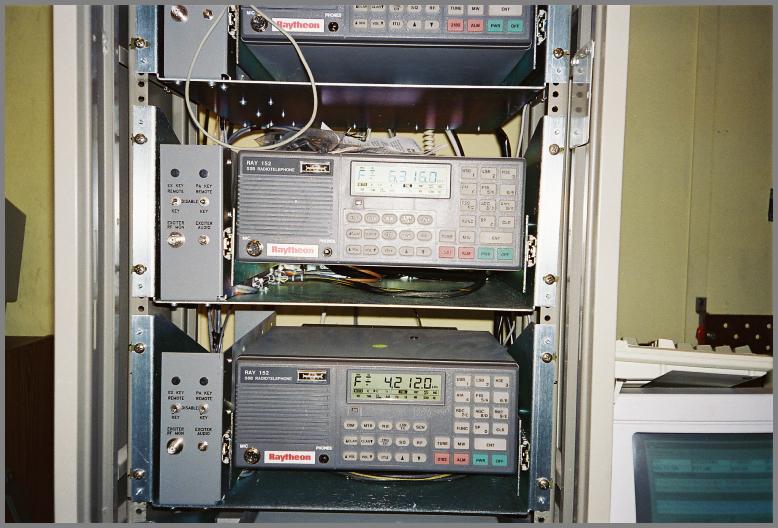 Some of the WLC HF Transceivers in 1997 - Photo by Joe Olig |
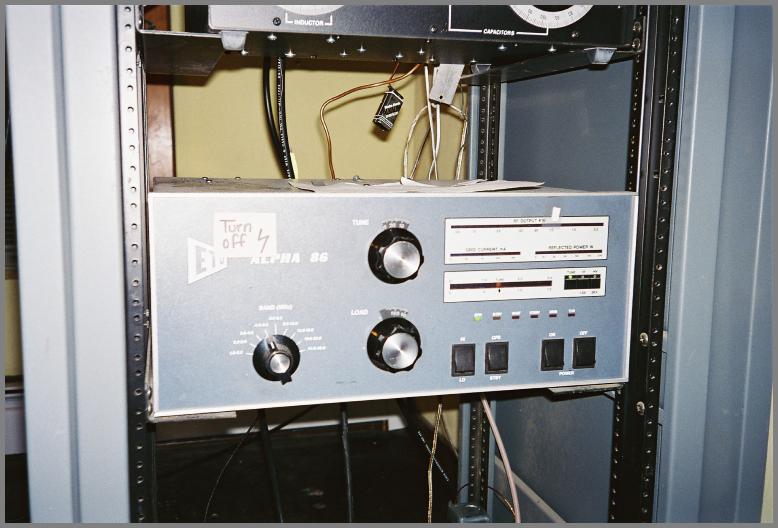 The HF Power Amp at WLC in 1997 - Photo by Joe Olig |
|---|---|
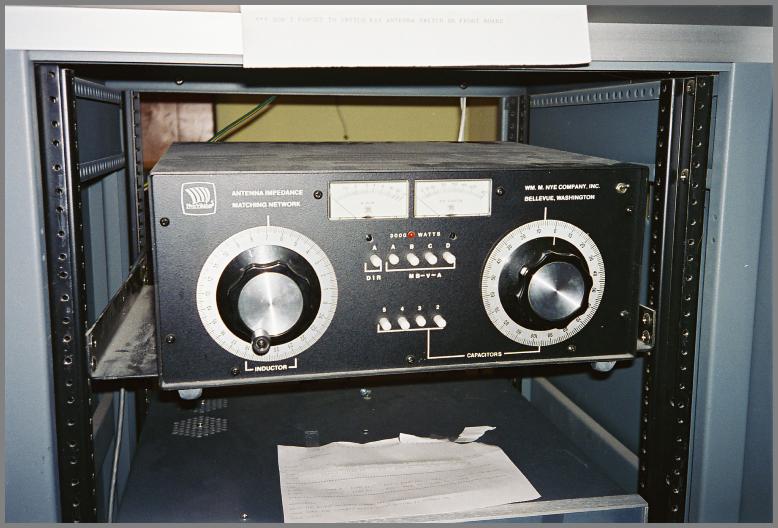 The WLC HF Antenna Tuner in 1997 - Photo by Joe Olig |
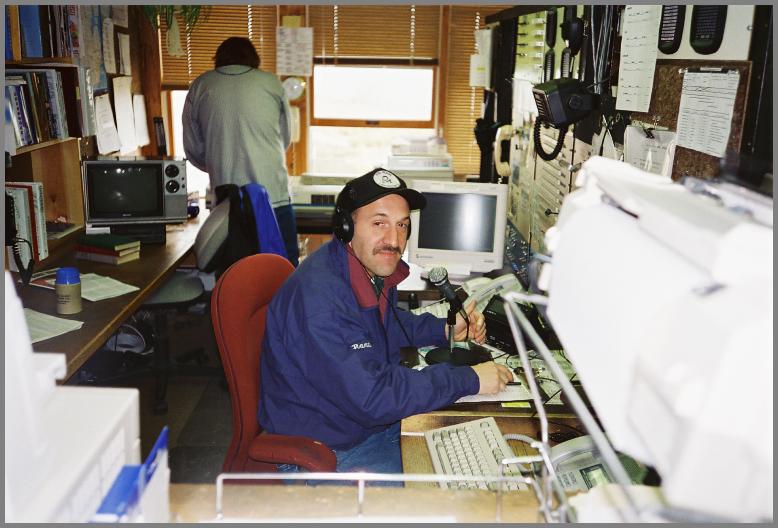 Owner Randy Martens Operating - 1997 Photo by Joe Olig |
|---|---|
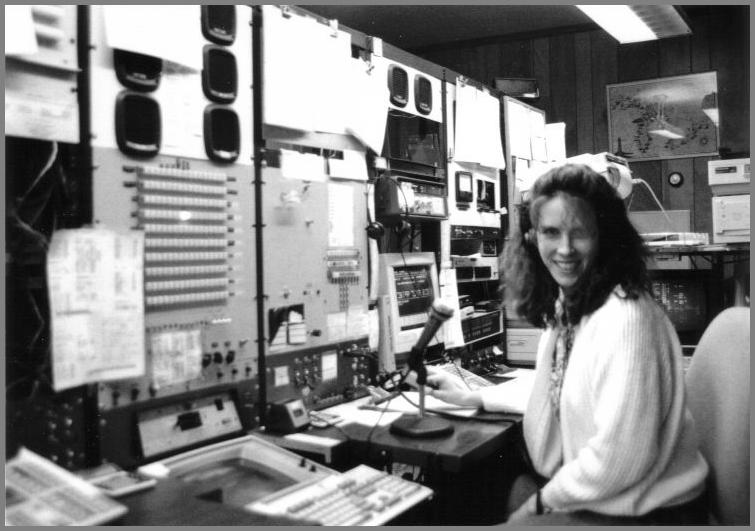 Denise Roeske at the Controls - 1990s photo by Jim Leow |
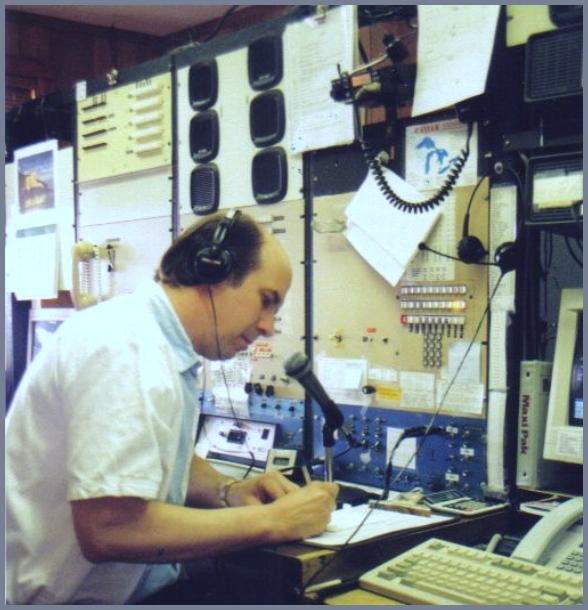
|
|---|---|
 WLC from Lake Huron |
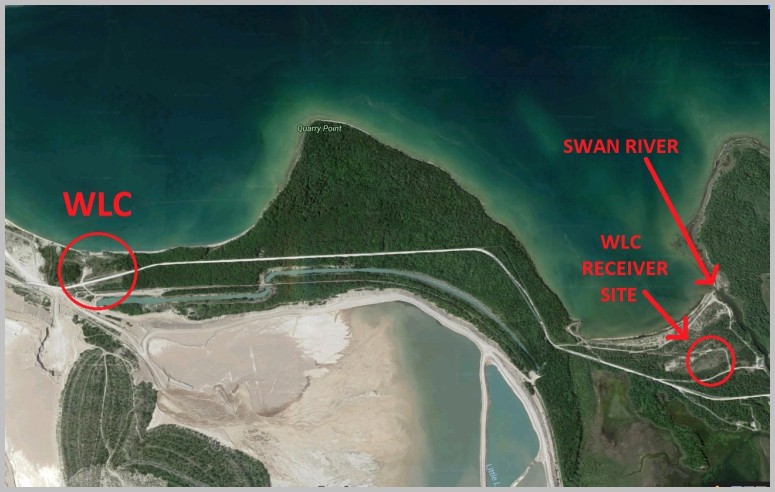 Aerial view showing the remote receiver site location |
|---|---|
WLC had a remote receiver site on the Swan River about 2 miles from the WLC transmitter site. At this site there were several turnstile antennas for the HF frequencies, a small building for the SSB receivers, and a back up generator. Bob Haworth, KD8EKH, a dedicated WLC listener in the past, provided these photos.
Jim Leow sent me these four scenic photos which are typical of the great views that the WLC crew often enjoyed from the station's location right on the Lake Huron shore.
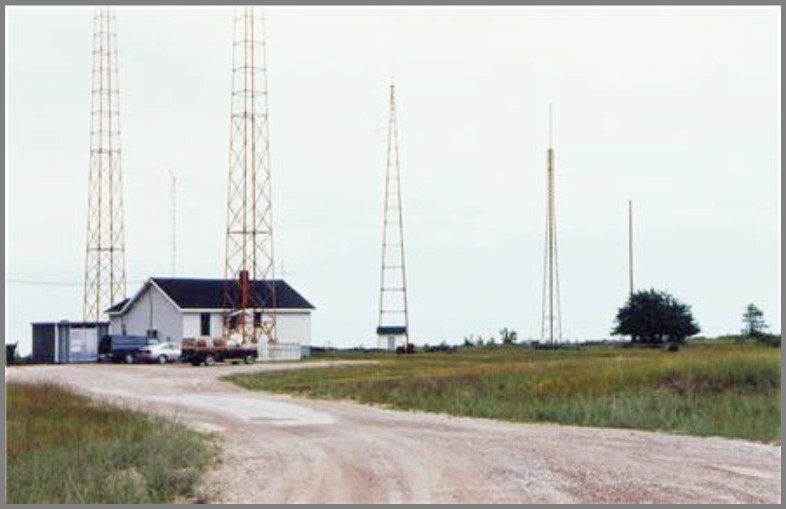 Bob Ballantine, W8SU took this shot showing most of
the WLC antenna farm just prior to the station's closing in 1997. |
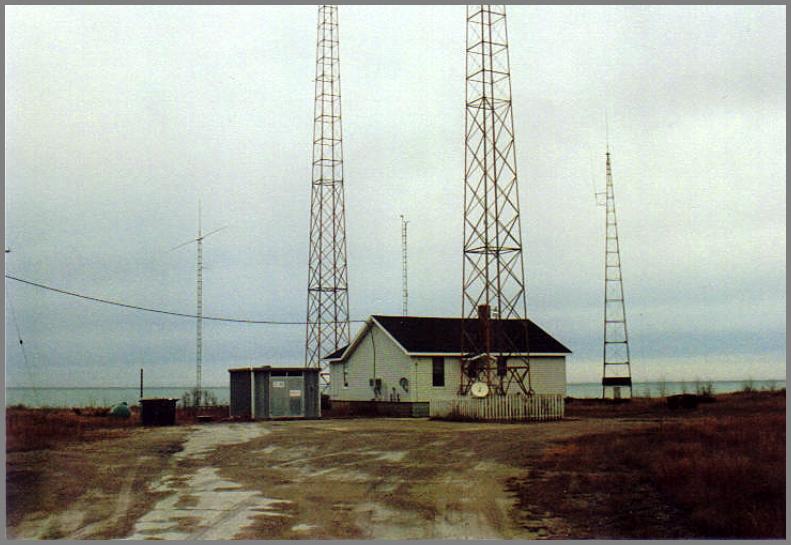 Jim Leow took this photo on a dreary November 28, 1997 when WLC, the last of the Public Coastal Stations serving the Great Lakes, went quiet - SK |
|---|---|
Here's the Schedule for the operation of the station during the 1997 season, and here's the SITOR (?) morning traffic list for Nov. 25, 1997, just a few days before the station's closing.


Below are two short video clips of the captain of the M/V Burns Harbor, WQZ-7049, talking to WLC, one of them on WLC's last day of operation. They will play on any of the common media players. The video versions are multi-megabyte files and even with a high-speed connection they may be a slow download. To substantially reduce the download time choose the much-smaller MP3 audio versions .
MPG Video - April 13, 1996 and November 28, 1997 MP3 Audio - April 13, 1996 and November 28, 1997
Terry Miliczky, KB9IHU supplied this 8 minute MP3 recording
of WLC talking with a number of boats on Channel 405 on
a late fall day in the mid-1980s. The weather was
rough that
evening on the lakes because of a fall storm. The clearer
voices
are the WLC operator and a company dispatcher who is on the phone line.
The weaker audio is from the boats, but as heard at, and
repeated
by, WLC.
Weather information was very
important to the boats and WLC tried hard to fill the need with both
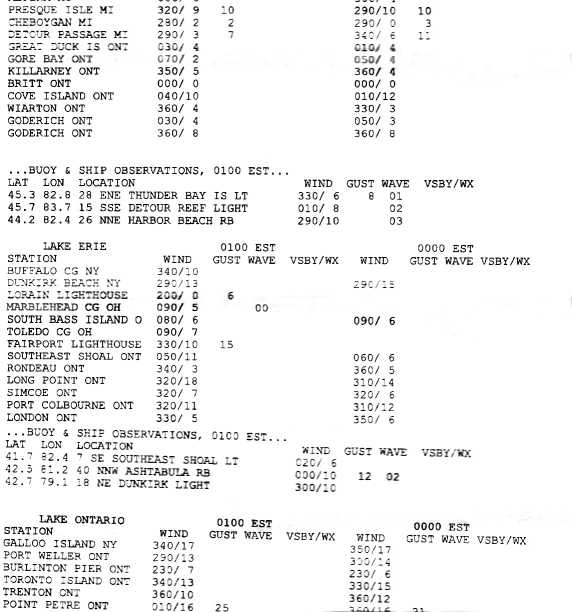
weather reports and faxed weather maps. Here's a portion of a typical
Lakes weather
report. William Hepburn has provided a truncated
version of a LAWEB broadcast from WLC in the
early 1980s. There is a silent period in the middle of the
recording.
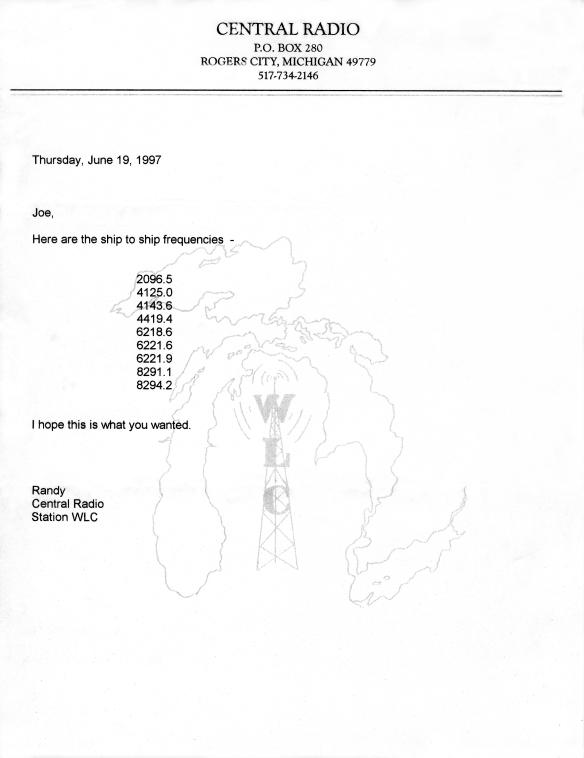
WLC had very nice watermarked stationery.
It seems that WLC was a leaner operation than WMI and thus was able to offer lower rates, and this undoubtedly contributed to it's longevity vs. its Ohio competitor. Randy and Sue ran WLC until 1997 when it became apparent that the competition from satellite and cellular was too much, and it was no longer feasible to keep a 24 hour manned station on the air. As the caption for the picture above indicates WLC's last full season of service to the lakers ended in 1997.
The current state of the WLC building and towers is unknown to me. Sometime after the 1997 shutdown Randy tried a SSB e-mail system. It worked well, but the shipping companies felt going back to SSB was stepping back, and instead they use a satellite email system. So WLC went off the air again, and it's FCC license expired in 2013.
Ex-operators report that in its later
years WLC was an informal operation - the operators were known by name
to the boat captains.