
Marine Radio Gear and Its Maintenance
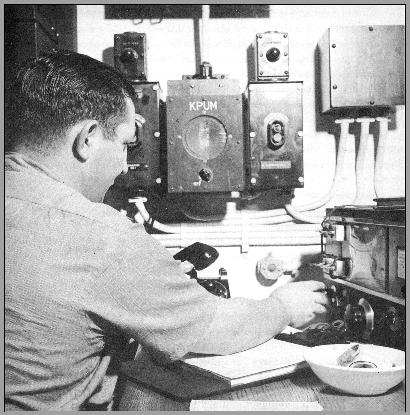 Unknown Towboat's 1947 Radio Setup |
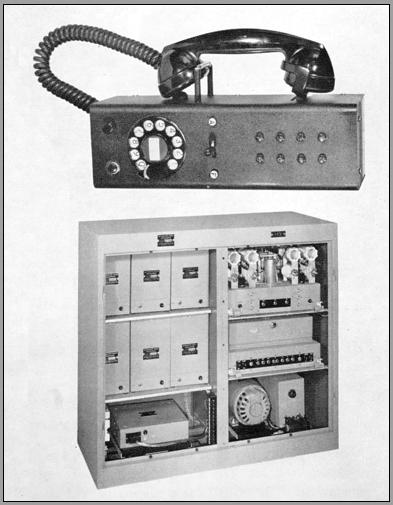 1951 Lorain County Radio Shipboard AM Unit |
|---|---|
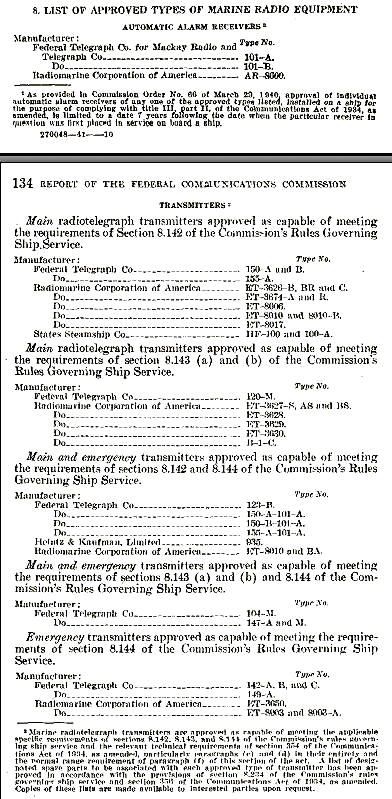
Look at those (manual-antenna-changeover?) knife switches on the left front of the receiver the operator has his hand on. Pictures in the 1998 AWA Review indicate that it is a National R-115 AC/DC Coast Guard receiver which was first manufactured about 1940. A clear picture of it is at The Museum of radio and Technology. Here's a list of Type Accepted gear (all radiotelegraph) from the 1940 FCC Annual Report. However, in another place in the report it is indicated that a survey showed that 20 companies were making radiotelephone gear of 80 different types with prices from $99.50 to $2450.
Certainly Lorain Electronics (and its predecessors) was a very strong supplier of shipboard gear on the Great Lakes and to a lesser extent (?) on the rivers. RCA or RMCA (Radiomarine Corp of America) was another leader in the ship-to-shore field. Other names associated with shipboard radio gear were Mackay, Canadian Marconi, R. F. Communications, Northern Radio, and Raytheon. When SSB came into use around 1980 ICOM equipment became popular on the Great Lakes boats and CAI gear was used by some of the stations.
As we obtain information about the various suppliers we will link to separate pages for them here:
While I don't have any information about Canadian Marconi Marine gear Jerry Proc, VE3FAB has the definitive Canadian Marconi web pages. Browsing and searching there should produce information on marine radio gear. Jerry also has some pictures of a Marconi CSR-5 Receiver and FR12 Transmitter (at the bottom of the page). Much information about the CSR-5 receiver and a beautiful photo of it can be found near the bottom of this Radio Boluvard page.
This Chum Bucket page has information and images on radios designed for use on yachts. The same site also has a Radio Direction Finder page.
This Dutch high seas radio officer's page has hundreds of photos of high seas ship radio installations. In Dutch - Google Translate helps.
This Marine radio pictures (mostly UK and European) site is now only available via the Wayback Machine .
The best information received so far indicates that during the HF radiotelephone era there was only one emission type change (AM to SSB) 1977-9. I know that all my early listening (1947 to 1956) was AM and that my Drake TR-7 was purchased in the early 1980s at least partly because all the marine stations were then using SSB and I had no other way to receive them.
The multiple-tone ringer system was a significant invention - selective calling of each boat. Somewhat equivalent to a boat having its own phone number. It kept much static and other traffic out of the pilot house. Information in the Hallicrafters HT-8 instruction book indicates that there was an external Western Electric Model 104A ringer option for that rig in 1939. Therefore, though RCA mentions a ringer in their 1951 ad, it appears that they were not the pioneers here. I wish I knew more about the ringers: things like: Were the ringers later integrated into the transceivers? Who manufactured them? Who assigned the ringer numbers? How many ringer numbers could be assigned without duplications? Thomas Drake provides some answers to these questions on his recollections page. A 1941 FCC document indicates that both Lorain and RMCA had selective calling options for their shipboard gear and that it was the norm on the Great Lakes at that time.

It's a big step from 1951 in the previous
paragraph to today, but most ships today are required to have an AIS (Automatic
Identification System) that uses existing VHF
channels. All ships on Great Lakes and St. Laurence Sea Way
must have this equipment since it automates the VTS (Vessel Traffic
System).