 |
WAY
|
Ship-to-Shore station WAY served the ore
carriers on Lake Michigan headed to Gary Indiana steel mills and
towboats, many on the Illinois river but on the other rivers
also. I remember hearing WAY many times during my teenage
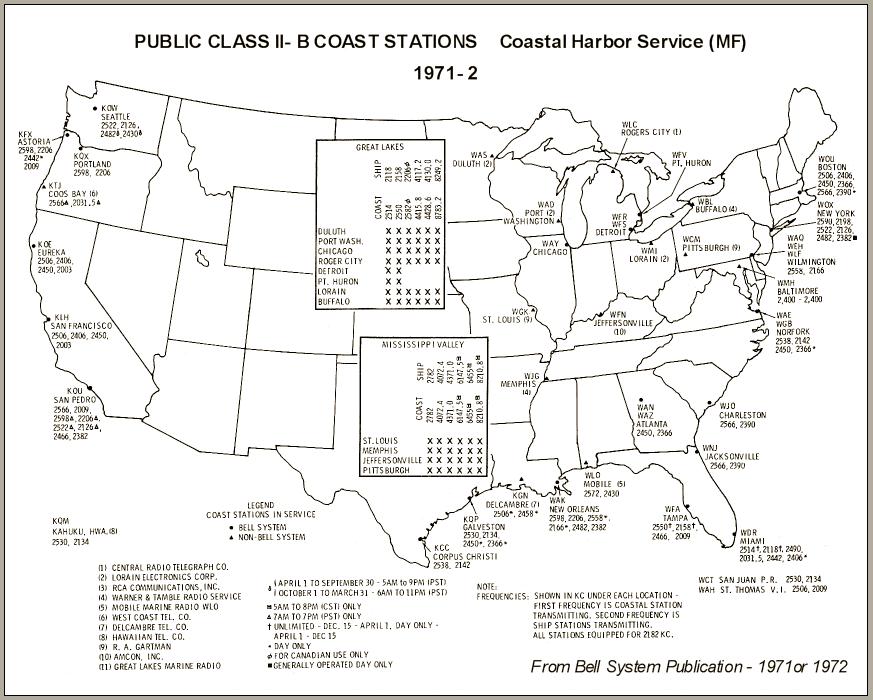
years in Indiana. However the 1971-2 AT&T map
erroneously shows only frequencies for the lakes. The 1971-2
map shows it as a Bell System station, but it's missing on the 1976
map. However, the station did not cease operation until April
of 1978.
The
June 30, 1937 FCC Annual Report indicates that during the fiscal year
Thorne Donnelley had applied for a radiotelephone station at Lake
Bluff, IL serving the Great lakes and particularly the southern end of
Lake Michigan. The application was set for a hearing before an examiner on July 8, 1937. One year later the FCC Report indicates that
the Lake Bluff application had been approved during the past 12
months, and the station came on the air in May of 1938 using 2514
KHz for transmitting and 2118 KHz for receiving. This local newspaper article confirms first operation about that time. The 6/39
Report
states that WAY had applied for
increased facilities during the past 12 months. These
increased facilities may have been for frequency allocations above 3
MHz which were approved during the FCC fiscal year that ended June 30,
1941.
The FCC Annual Report for the fiscal year ending June
30, 1943 indicated that public hearings had been held on the
application of WAY for authorization to communicate with ships on the
Mississippi River and connecting waterways.
WAY was not Thorne Donnelley's only commercial marine radiotelephone venture. See the FCC records for more about his other station WHC Mackinac Island, MI and its 1941 ownership transfer from Donnelley to The Central Radio Telegraph Co. and its subsequent relocation to Rogers City.
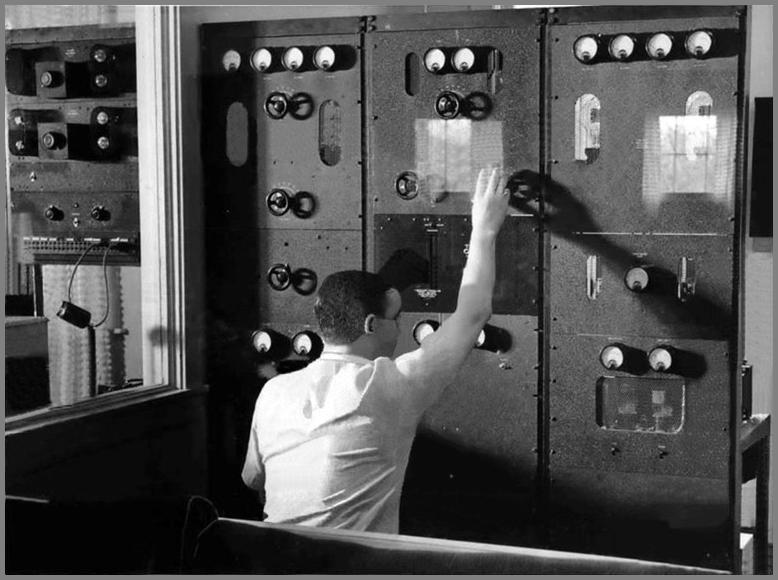 The
photo below shows Mr. Donnelley at the controls of the newly
licensed WAY. |
 WAY's Lake Bluff location |
|---|---|
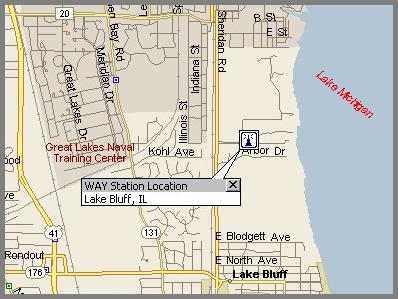
WAY
was really located about 30 miles north of Chicago's Loop off Sheridan
Road in Lake Bluff, IL - about 600 yards from Lake Michigan.
It also had auxiliary facilities on Chicago's Navy Pier (2MHz and VHF)
and remote HF receivers in Glencoe and Zion, IL.
Unless
otherwise noted all photos on this page are
courtesy of
Robert Weppler
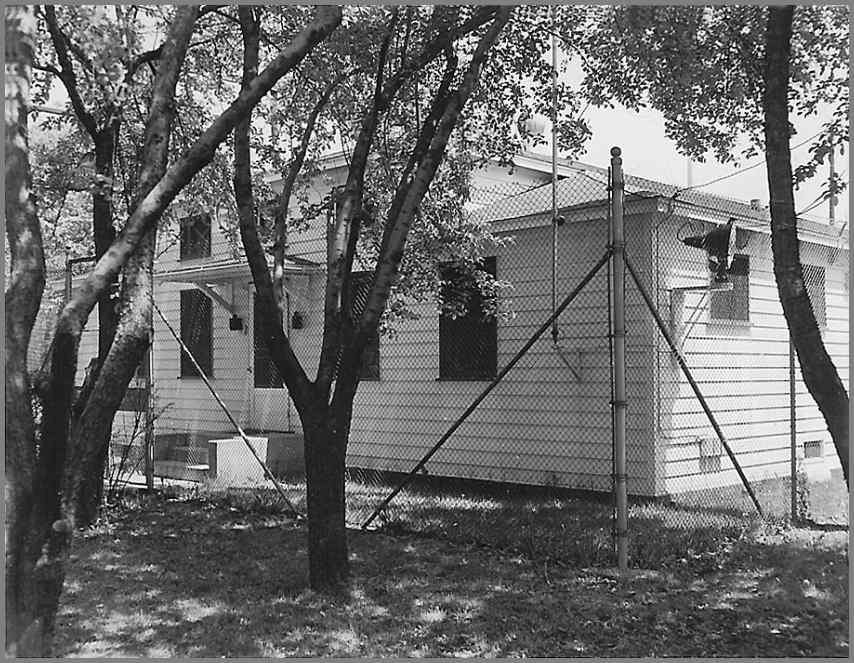 WAY Building |
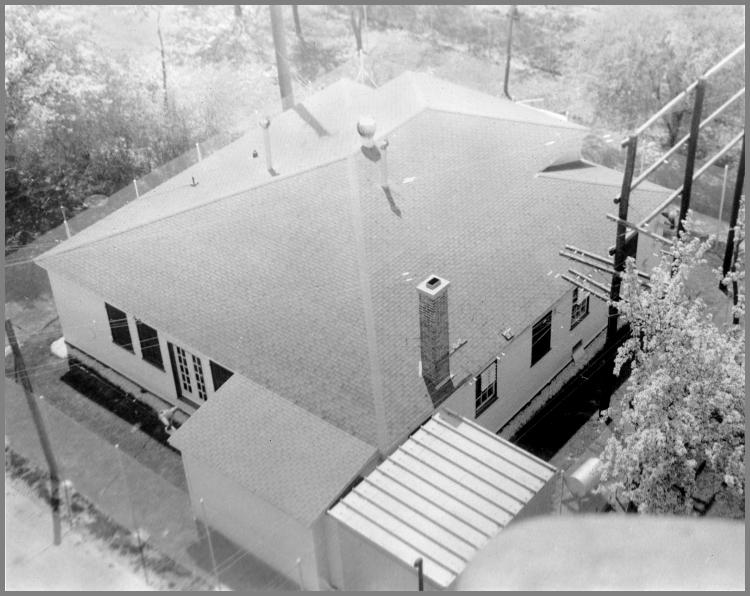 Lloyd Frye took this photo of the WAY building from the top of the truck-tower that the WAY crew used for remote TV pickups. The metal addition with the corrugated top housed a large diesel AC generator capable of powering the building. Starting and switching were manual and it was test run regularly |
|---|---|
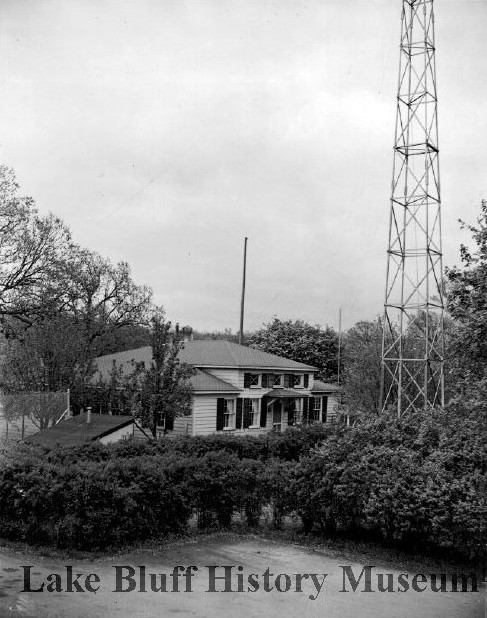
This WAY building and tower photograph is courtesy of the Lake Bluff History Museum.
Several former operators at WAY
have told similar stories about WAY's unusual beginnings which were
roughly as follows: Thorne Donnelley was the son of the
founder of the telephone directory publishing company R. H. Donnelley
and a Chicago radio pioneer. In the early 1920s he was one of
the founders of Chicago's first station WDAP
which later morphed into Chicago powerhouse WGN, and he was one of the
founders of the National Broadcasting Association. In the
1930's he sponsored hamfests on his estate at Lake Bluff, and used his
amateur radio station (W9PZ) there for marine communications with boats
on Lake Michigan. This and a perhaps a little prodding from
the FCC may have been the genesis of the idea for a commercial marine
radiotelephone station. In any case, as indicated above, the
license was sought and approved. A FCC Docket
dated October 9, 1940 indicated that WAY was then operating at huge
losses & was being subsidized by Donnelley who strongly
believed in
the station's
future.
When WW2 broke out oversight
control of all marine ship and shore stations was given to the Navy
which restricted all unnecessary marine radio communications.
Additionally, in April 1942 Donnelley entered the military
service. It's unclear whether Donnelley or the
federal government instigated the idea, but in the end the Bell System
(Illinois Bell) took over the station. Its purpose
then being communicating with the big boats that were so essential in
moving the ingredients required for the northern Indiana steel mills to
maximize production for the war effort. Depending on the
source both 1941 and 1942 are mentioned as the time of the Illinois
Bell takeover.
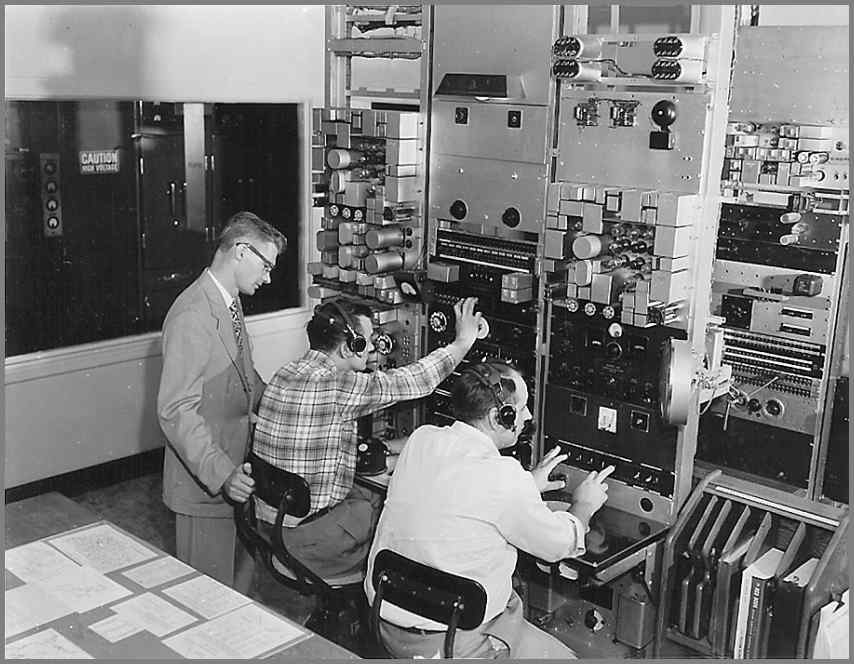 WAY Operating
Room - ca. 1952 The supervisor is
Dick Klavohn. The operator on the left is Bob
Heile. The operator on the right is John Tobias |
 |
|---|---|
 |
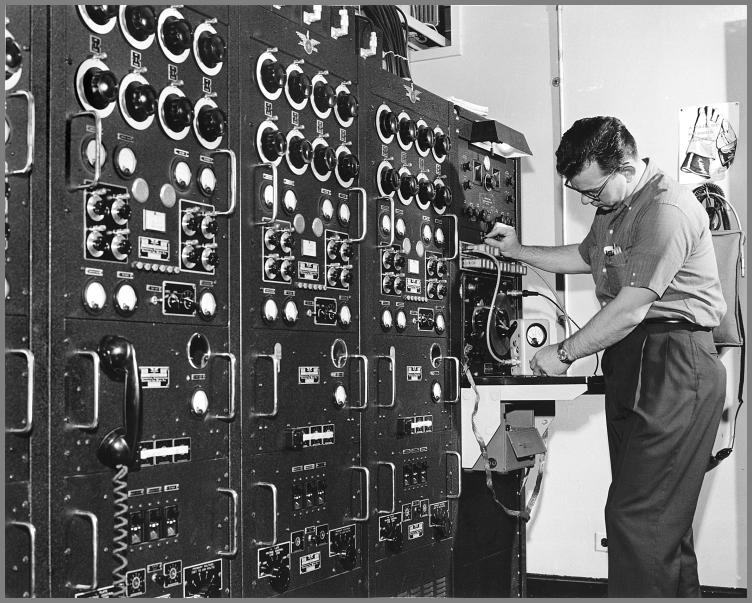 Lloyd Frye provided this photo showing him working with
the "new" 1KW Aero-Comm transmitters - ca 1960. |
|---|---|
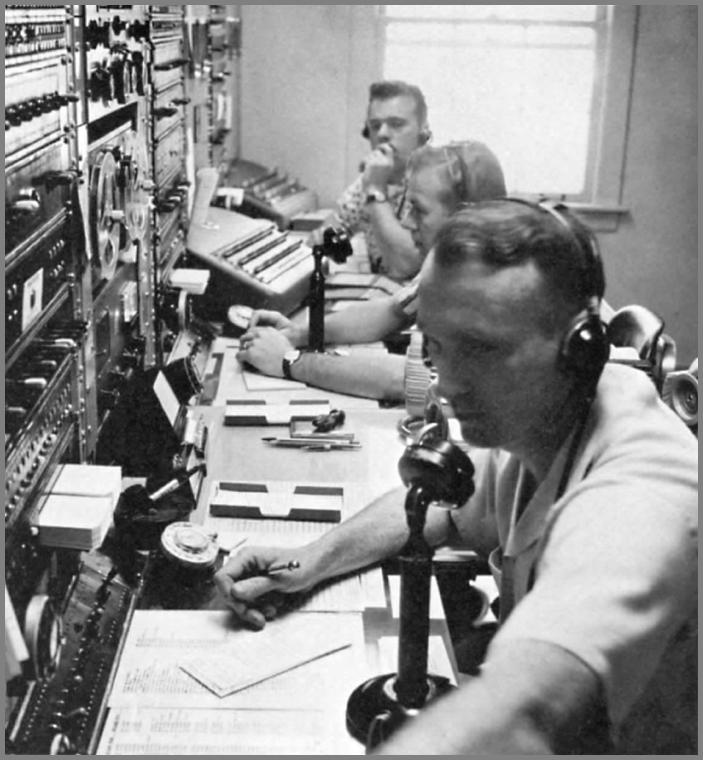
 Dale Long at the WAY controls in the early 1960s |
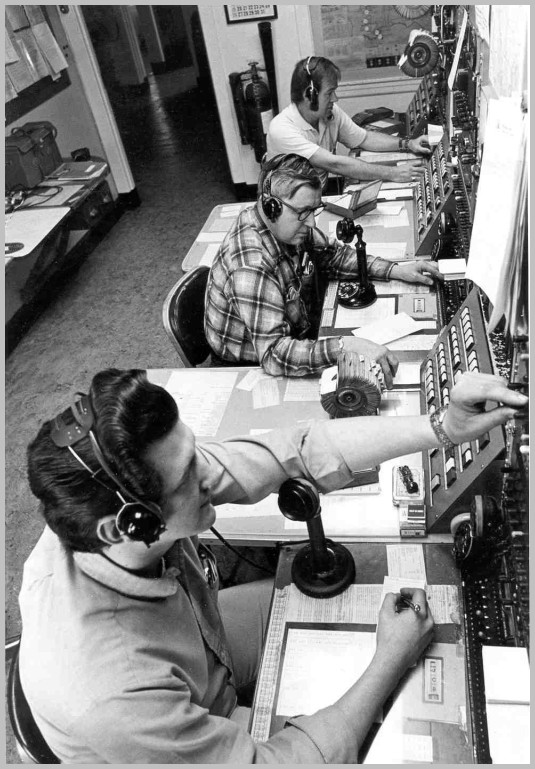 Jim Bresemann is shown
operating WAY in 1972 - Click/Tap on
the photo to see a larger image which shows Earl Rees in
the center and Ralph Modloff in the rear. |
|---|---|
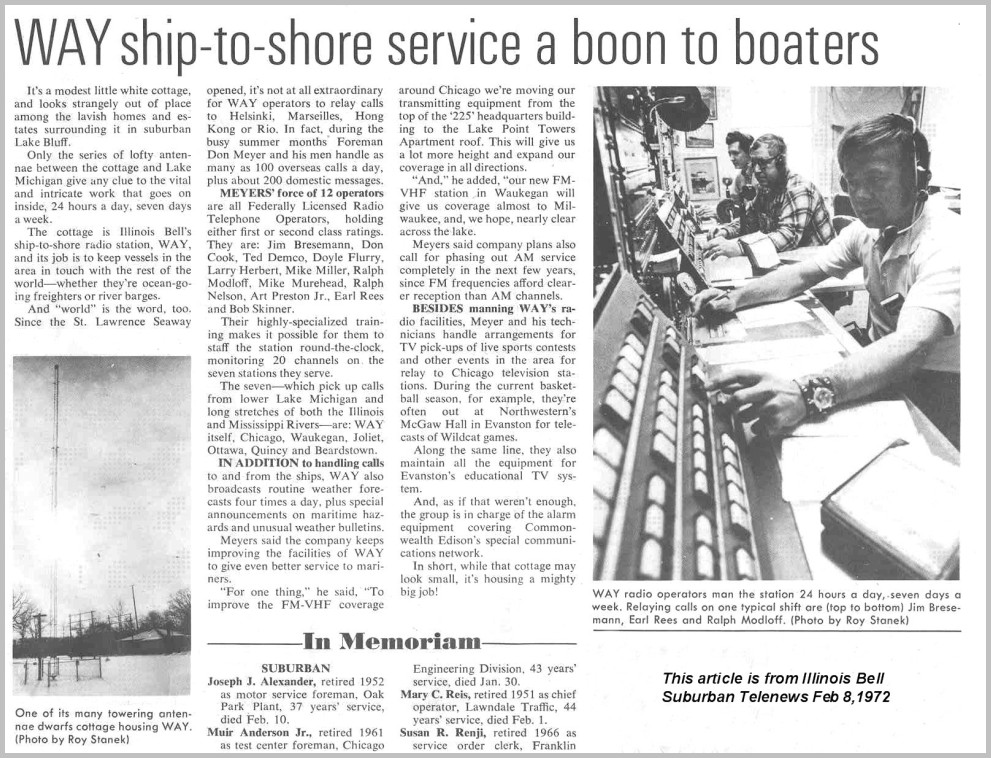
Jim Bresemann provided this 1972 I1972 Illinois Bell article
which includes a photo of one of the WAY antenna towers and another one of the three operators taken from the opposite end of the room. The article also states that WAY had 12 operators at that time and was in the process of improving its VHF-FM coverage via a new station at Waukegan and a relocation of the Chicago station to a taller building.
WAY was a 24/7/365 operation. There were 3 shifts, days, evenings and nights. Some shifts worked 10 days straight followed by 4 days off. Holidays were just another work day. It
appears that WAY was not a rigidly formal operation as some of the
captains and pilots knew the operators by their first names.
During the lakes shipping season WAY broadcast the MAFOR weather data every 6 hours (less during the winter), and during some years WAY held regular company schedules with
the river boats where all of a barge company's boats called in with
their position, fuel reserve, tow makeup, etc. One
operator stated that several of the barge companies had their own
shortwave receiver and could often hear the boats better directly than
they could through the WAY phone patch. Of course, they
transmitted back to the boats via the WAY phone patch.
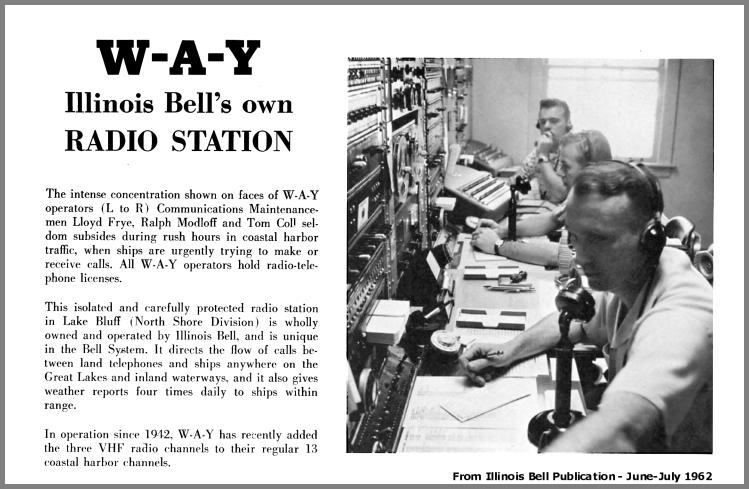
Here's a short 1962 Illinois Bell
article about the station that indicates that WAY was authorized 13 shortwave frequencies at that time. One was 2182 and there were 6 for the rivers and 6 for the lakes.
WAY operators would receive and pass calls to LD ops, (usually females) in Chicago - there were no female ops at WAY. For a time, land callers placing calls to the Chicago Marine Operator would reach an operator who would then pass the call to WAY for completion. Early on, calls originated by ships were passed to the local LD operator, and later (once the capability was in place) they were dialed directly by the WAY operators . The ships had accounts with WAY or would use "collect" or credit card. For a time, the WAY operators filled out billing tickets that were sent daily to a billing group.
Like several of the other Inland Marine stations WAY occasionally made contacts with aircraft. One op remembers contacting N1M - Arthur Godfrey's DC-3. Another op recalls occasional contacts with N7UP, not the soft drink company, but Union Pacific Railroad.
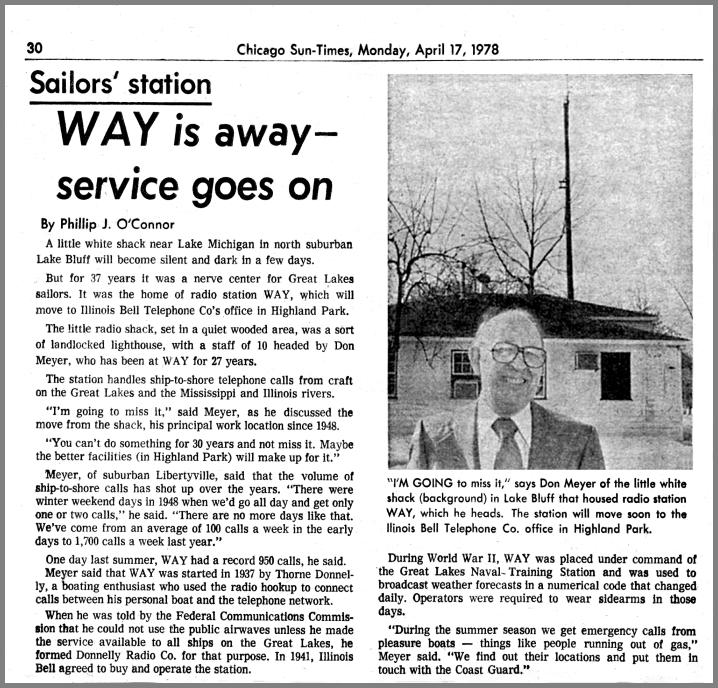
While there were some tests in the late 1950s using Collins SSB gear with the Great Lakes excursion boats SS North American and SS South American WAY never made the transition to SSB operation - instead ceased all HF operation at the Lake Bluff site in 1978. Here's a Chicago Sun-Times article about the closing of the station but also containing some historical tidbits.
The short Illinois Bell article mentioned above indicates that WAY began VHF-FM operations about 1962. The RF equipment for WAY200, the VHF-FM Chicago station, was first located on the Illinois Bell Headquarters building at 225 W. Randolph Street and then, starting in 1972, on the Lake Point Towers apartment building, one of the highest buildings in downtown Chicago. The five other VHF-FM stations controlled by WAY operators were: One located on the lake at Waukegan (KTD564) - Three down the Illinois River at Joliet (KOU582), Ottawa (KGW318), and Beardstown (KGW322) - And one on the Mississippi River at Quincy (KGW405). When the Lake Bluff WAY site closed in 1978 a new control point for the 6 station VHF-FM network was established at the Highland Park central office. There 4 operators used older switchboards converted for radio use. The landline connections for these stations were handled by the operators - nothing automatic about this system. The charges were $4.50 for the first 3 minutes and $1.50 for each additional minute. The network was operated from this facility until about 1983-4 when the stations in the network were sold to LEC (WMI). Jim Bresemann, who worked at both Lake Bluff and Highland Park, provided the two photos below.
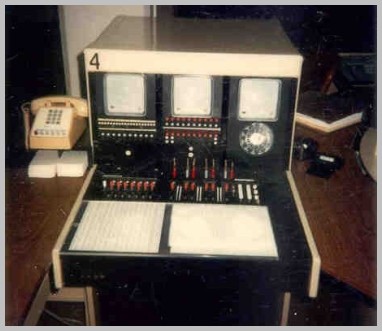 One of the four operator positions at Highland Park. |
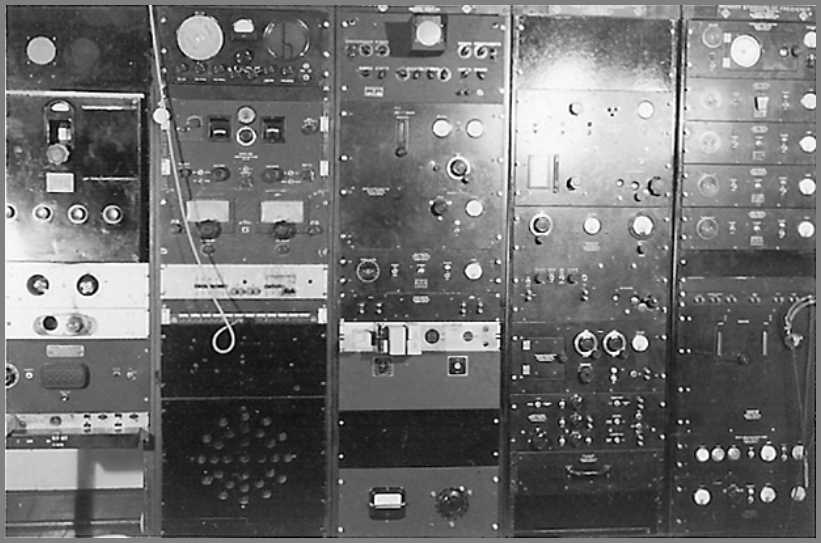
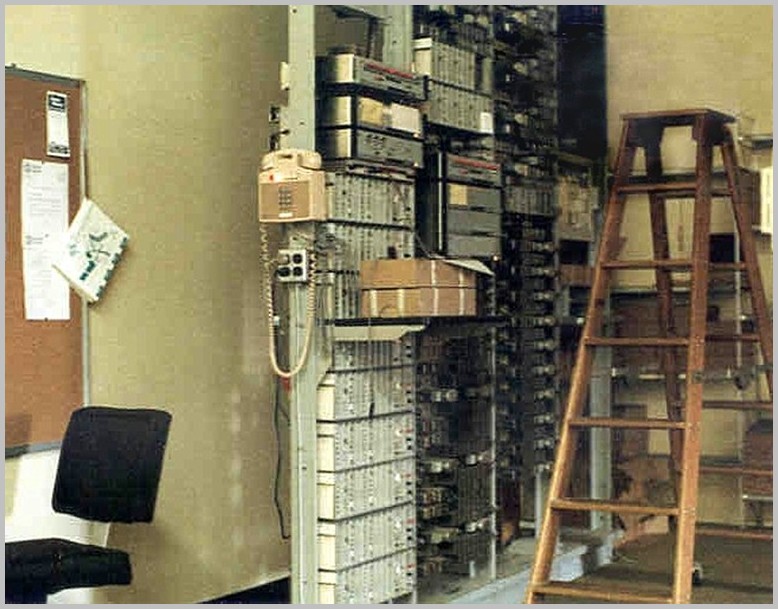 Only 4 racks of electronics were required at Highland Park to remotely control the 6 station Illinois Bell VHF-FM network. There is no RF gear in these racks |
|---|---|
The WAY operator crew didn't just sit around waiting for marine calls. The operators' official titles were Communications Maintenance Men, and they certainly lived up to the title. In addition to serving as operators at the station they did multiple jobs having responsibility for some of Illinois Bell's mobile telephone and microwave work, frequency measurements for broadcast stations, maintenance of the power company's mobile gear and even some remote TV pickup work for TV stations. They were a busy bunch of guys!
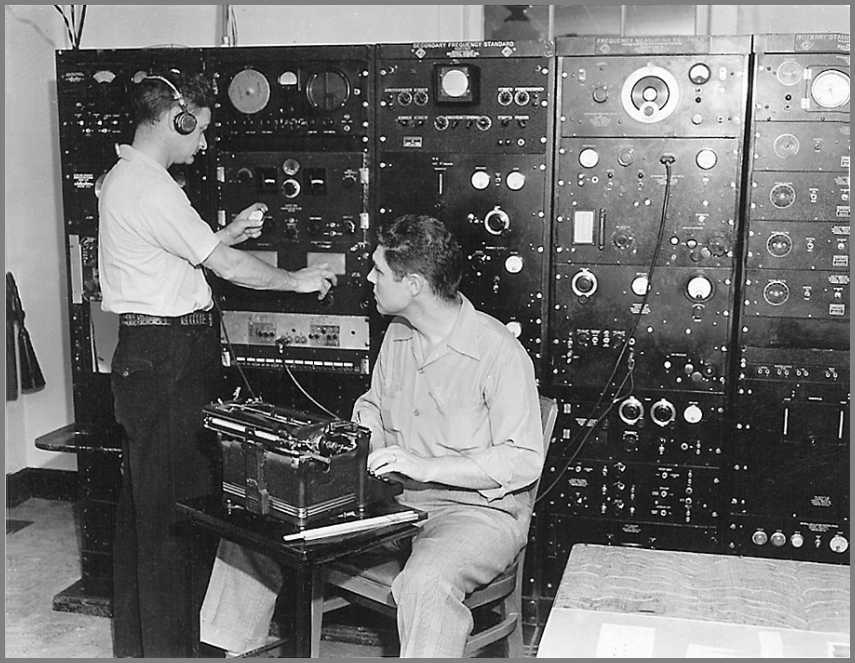 Primary
frequency standard on the right and secondary
standard on
the
left. Joe Bolsinger (left) and Larry
Gilbrith making a frequency measurement |
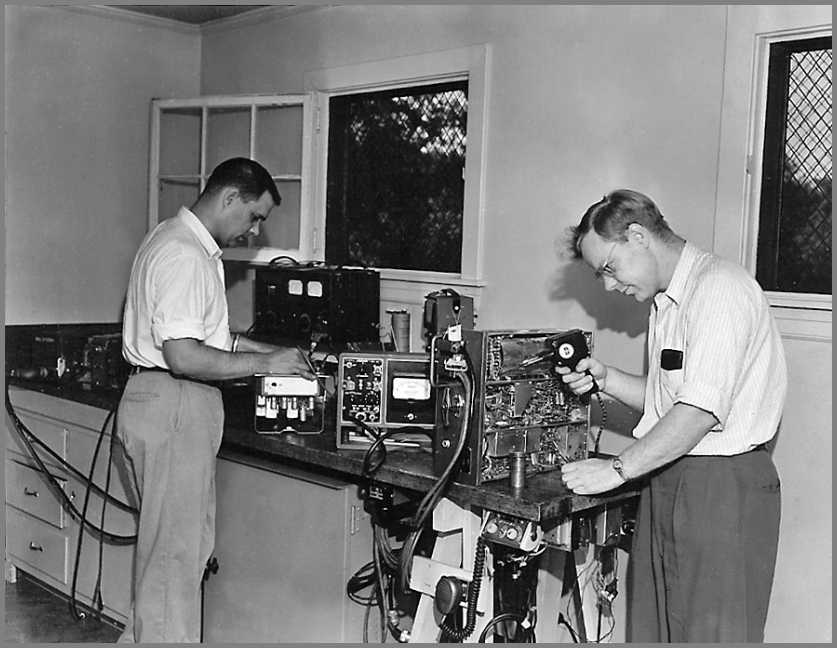 Warren Glasel (left) and Ralph Nelson in the repair shop. |
|---|---|
Here's a better view of just the monitor receivers and frequency standards.