WJG - Memphis, TN
The idea
for WJG, the first radiotelephone station on the inland rivers, was the
brainchild of two men: Loyd J. Carlson was the Chief Engineer and the
technical brains while Russell V. Warner provided the funds
and industry connections. Not much is known about Carlson as
he left the station in 1945. Warner was known by the men on
the river as "Skipper," He began his career in 1908 as a
15-year-old coal passer. By 1913, he had earned his first
river pilot's license. Ten years later he brought the first
commercial towboat through the then newly-opened Lakes-to-Gulf Waterway
into Chicago. Later, he piloted the first diesel towboat, the
Mary Elizabeth, on the lower Mississippi River. In
the 1930s he and George H. Tamble combined their river related
businesses to form the firm Warner and Tamble.
Though
the federal government
used CW for communication with it's boats, prior to 1936, commercial
towboats on the inland rivers had no way to communicate with those
ashore. If the boats needed provisions or assistance in an
emergency, they had no recourse but to keep on steaming until they
reached the next town or settlement. Carlson and Warner
realized that installation of radios aboard the towboats and ashore
could potentially save money and lives. But getting a
Ship-to-Shore radiotelephone station authorized in 1936 took some
doing. The 1937 FCC Annual Report indicates that R. V. Warner
and G. H. Tamble applied for a radiotelephone station at
Memphis on 2558 KHz. The application was heard before an examiner on May 7, 1937, but on April 13, 1938 it was denied because the
Commission had allocated 2558 to New Orleans. However, the
Commission suggested a re-application for 2538 KHz would
likely be
favorably received. The 1939 report indicates that a station at Memphis
had
been licensed. When it came on the air, WJG was an AM
operation on the HF (high frequency or shortwave) bands. Could 1936-1938 operation have been
experimental?
In a 1977
interview, Warner said, "I remember that the government didn't want to
give us a license for two-way radios. They said there was no
need for it. But other fellows," he continued, "didn't think so, and so
we got Old Man McKellar (Senator Kenneth McKellar, the dean of the U.S.
Senate at the time) to pull a few strings and that helped change a few
minds. Once we got the go-ahead, radios went like
wildfire."
Much of the information about WJG's early
years was provided by Jack Estes and his recollections
are interesting reading both for additional information about WJG
(including the early frequencies) but also about the early years of
other river stations.
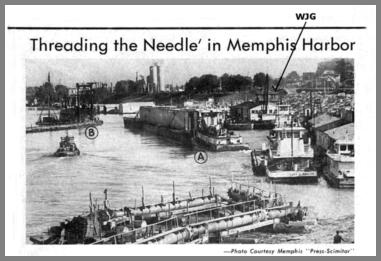 WJG's First Location on a Memphis Harbor Barge |
 |
|
|
John Gill has provided this more detailed (ca 1949) photo of WJG's first home, the Warner and Tramble barge. The barge roof lettering reads: WARNER AND TRAMBLE RIVER EQUIPMENT SHIP TO SHORE RADIOTELEPHONE "WJG"
G. H. Tamble was not actively involved
with the WJG part of W & T, and according to his obituary
died in 1951. Warner continued to run WJG as well as the
thriving towboat business. Here, courtesy of
Jerry DeGregory, Jr., is a 1967 WJG advertisement
which ran in the >Waterways Journal, and an enlarged
view of the photos
from that ad with caption information added. The ad includes
the only photo we have of "Skipper" Warner.
Warner retired in the late 1960s, and
passed away in 1983 - see his >obituary.
In late 1968 or early 1969 he
sold WJG to Raymond Gartman, the owner of WGK and WCM.
Gartman operated the station for 3 years and made many
improvements. He sold to Terrence B.
("Bill") Miller (W4JLA) in 1971 and Miller owned
the station at least through 1982. There is more
about the station during Miller's ownership in this 1982 newspaper article.
Mark Gartman
worked both for his father and for Bill Miller, and his recollections provide much
information about his father's ownership of the three river stations
and his own working years at both WGK and WJG.
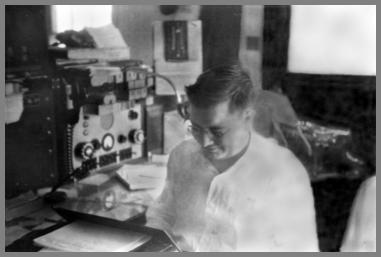 Jimmy DeHart Operating WJG - Late 1940s Jack Estes Photo |
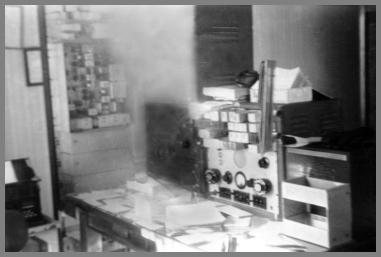
WJG Operating Console - Late 1940s Jack Estes Photo |
|
|
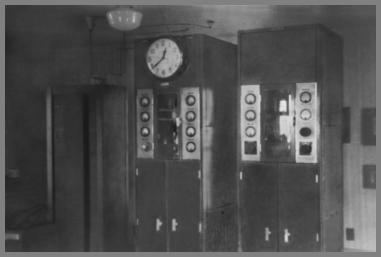 WE-14C 400 Watt AM TX at WJG's Second Location -
Jack Estes Photo |
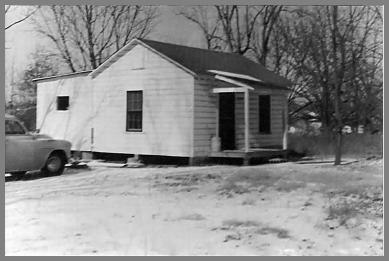 WJG shack -
Pecan grove
location - About 195? -
Photo Courtesy of J. L. DeGregory, Jr. |
|
|
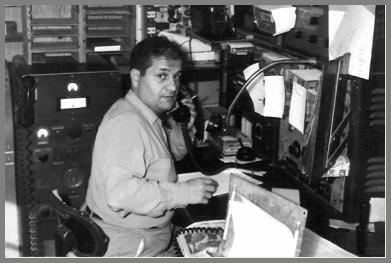 Jerry DeGregory at the WJG Controls - Barge location? -
Photo Courtesy of J. L. DeGregory, Jr.
|
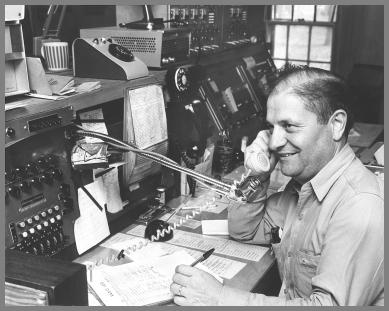 Jerry DeGregory at the WJG Controls -
Pecan grove location - ca. 1950s - Photo
Courtesy of J. L. DeGregory, Jr. |
|
|
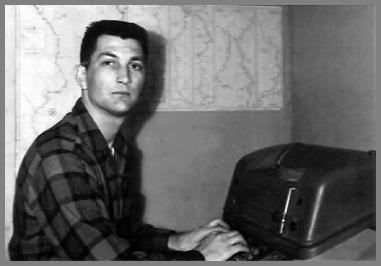 Operator Johnny Barbieri
|
WJG had 4
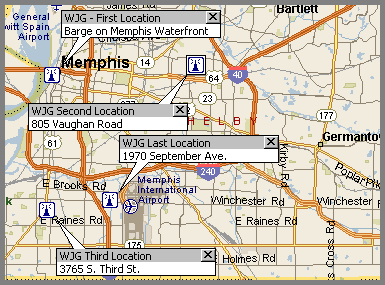
locations in Memphis. The first from 1939 to 19?? was on a barge as shown above. The second from 19?? to 19?? was near Skipper Warner's home in a large Pecan grove on Vaughan Road
just north of Tutwiler Ave. The third location from 19?? to 19??, where most of
the pictures below were taken, was at 3765 S. Third Street (Hwy.
61). The last location (probably only 2 or 3 years and FM only? was in a brick building on September Place (Ave?)
The succeeding years saw a
variety of technical changes and improvements as WJG continued to serve
the needs of the people on the river. New SSB equipment was
installed at WJG in 1967 well ahead of the mandated
changeover from AM, and AM and SSB were both in use for several
years. The addition of the first remotely-controlled VHF-FM
stations above and below Memphis occurred in 1971. They were
the beginning of a network of stations which eventually stretched from
Louisiana to Illinois. |
|
|
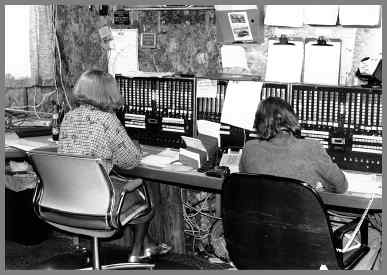 WJG Operating
Room - Hwy. 61 Location |
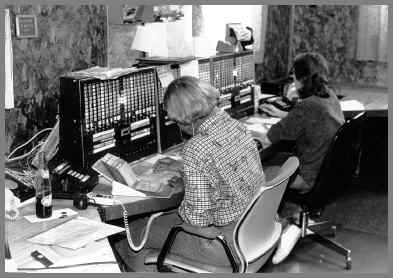 WJG Operating
Room - Hwy. 61 Location |
|
|
These 1989 views of the
second-floor
operating room show the two operators sitting before a Christmas
tree-like control panel of flashing red, yellow, green, and white
colored lights. Routinely, they completed over 8,000
ship-to-shore telephone calls a month - by 1989 most of them via a 13
station network of VHF-FM stations Map and
Frequencies remotely
controlled from the Memphis operating room. During the winter
months, this total went up even higher as mariners rushed to get their
cargoes and boats out of the upper Mississippi and Illinois rivers
before they were frozen in. Next to the console was the
handset for the SSB equipment (on the first floor) and its SELCAL
(ringer) gear. Out of sight behind the operators a small PC
on wheels kept track of the locations of towboats, and compiled
information on cargoes, barge transfers, etc. This information was then
passed on to the towboat and barge owners. Just outside in
the next room, an old National Weather Service teletype
clickety-clacked with information on river stages and other
meteorological information of interest to the rivermen.
Here are some views of WJG's
antennas
and building
at the Hwy. 61 location. The station wasn’t very
visible
from the highway, and there was a only a small one
lane
road leading to the area
where the station was housed.
WJG's old Channel 5 (2782 KHz) was by far
their most used channel in the late 1940s. Later on
additional frequencies were utilized the most common being 6455 (AM)
for daytime operations. The small white chart on the
SSB transceiver cabinet below lists 6 channels. Not all the
numerals are readable in the original photograph and some have been
erased, but the line-up was something like the following:
Frequency -
WJG Ch. #
2086 - Channel 1
2783.4 - Channel 5 (Erased)
6465.4 - Channel 2 (Partly erased)
408? - Channel 3
???8 - Channel 4
12??? - Channel 6
However, the business
card
below also
mentions a
Channel 7 so the chart doesn't tell the whole
story.
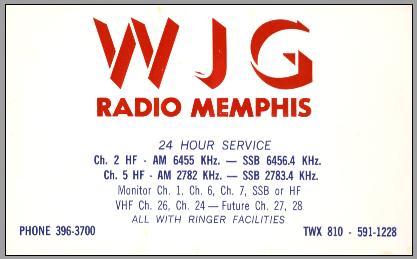
By 1989
WJG was mostly an FM operation and the only SSB frequency used
was 4087.8 KHz. In 1991 that was changed to 4089 KHz to
match the new ITU/FCC marine channels.
Here's a 1959 QSL card
courtesy of Jeff Yates
|
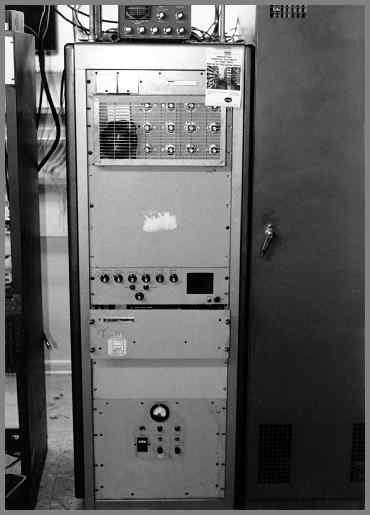 WJG's 1KW CAI HF Transceiver - 1989 |
|
|
WJG's license must have had some unique
license provisions or it received some special authorizations from the
FCC, for over the years, this marine station provided an unusual
variety of communications services. In the 1970s, a mining expedition
contracted with the station to provide them a means to contact their
home office from a remote location in the mountains of Colorado. Before
satellite communications were common, WJG was the expedition's only
link with the outside world for over six months.
The
mammoth overnight delivery service Federal Express has its global
headquarters in Memphis. WJG operators were sometimes called
by FedEx planes with requests to hook them up for phone calls with the
home office.
Stanley Adams, W4SBA reports that WJG was
also a licensed (certified?)
frequency
monitoring station. Via its frequency standard it provided area AM-FM
and TV broadcasters with their required monthly frequency
checks.
WJG was an informal operation.
The operators were known by name to the boat captains.
In the later years of operation WJG and
the 13 Station VHF-FM network were sold to Maritel. One of
the operators recalls that several of the former WMI/LEC Great Lakes
stations that Maritel bought were controlled from Memphis. Unfortunately, we don't know when Maritel took over the operation of the station and network.
After over 60? years of service
on HF WJG shut down its 4 MHz SSB operations in 1994. The
manually operated VHF-FM station network also ultimately fell victim to
satellite and cell-phone competition, and was discontinued in
1995. However, the Bits and Bytes Newsletter carried this
notice in 2003: "Maritel, Inc., which, along with its predecessors, has
operated marine voice service for 30 years is discontinuing the service
effective June 6. The company attributed the action to new
more efficient technology that has emerged in recent years,
and said "Marine VHF radio equipment simply has not evolved to meet
market standards."
Some
of the WJG crew and
their recollections
