
Great Lakes

Marie MacArthur Lock - About 1943 or 44 USACE Photo
Great Lakes history would be
incomplete
without recognition of the important role of the commercial radio
communications stations that served the bulk-carrier (iron
ore, coal, petroleum, cement and limestone) boats and freighters on the
Great Lakes. This service started with CW (Morse code)
operations on the medium and long-wave bands as early as
1910. WBL and predecessors of station WLC in Rogers City, MI
and a number of now long-gone stations were the pioneers. The
use of CW began to decline late 1930s when HF radiotelephone service
promoted by station WMI in Lorain, OH took hold.
The Early CW era is covered in detail on the CW Page.
The April 2022 issue of the The Detroit Marine Historian, a publication of The Marine Historical Society of Detroit, carries this excerpt about 1922 ship radiotelephones. It is from the Historical Collections of the Great Lakes at Bowling Green State University. Note: The only radiotelephone shore station in service in 1922 was WLC .
This March 1932 article in the Proceedings of the Institute of Radio Engineers presents the status of the Radiomarine Corporation of America's (Radiotelegraph) operations at that time. Howerer, by 1939 Radiotelephone had a solid start on the lakes, as detailed in this must-read article about early Great Lakes Radiotelephone Service. It contains the first mention of marine selective-calling that I have found. The code-wheel mentioned in the article is like ones mentioned in this Western Electric Type 60 Selector article.
In the late 1930s the FCC conducted an extensive survey of the use of radio on the Great Lakes. Though the final report of the survey is likely deeply buried in the FCC files, information about the survey process and progress has been exracted from the FCC Annual Reports for those years and is here: Great Lakes and Inland Waters Survey.
During the period from the mid 1940s to the mid 1970s AM (amplitude modulated) and by the early 1980s SSB (single sideband) ship-to-shore radiotelephone communications were the norm for Great Lakes vessels. By the 1950s only WBL and WLC were still using CW. There were as many as 9 shore stations providing radiotelephone service for a few years during this period. The FCC authorized frequencies in the 2, 4 and 8 MHz bands for this service. The 4 and 8 MHz frequencies were duplex pairs which allowed longer-range, telephone-like service through the shore stations access to the land-line telephone network. In 1944 the FCC had these Regulations for the use of radio on the Great Lakes.
In 1979 a Coast Guard Commander wrote this nice history of RadioTelephone on the Great lakes.
A report of early radio interference on the lakes : SHIPS RADIO IN 1938 ON THE GREAT LAKES .
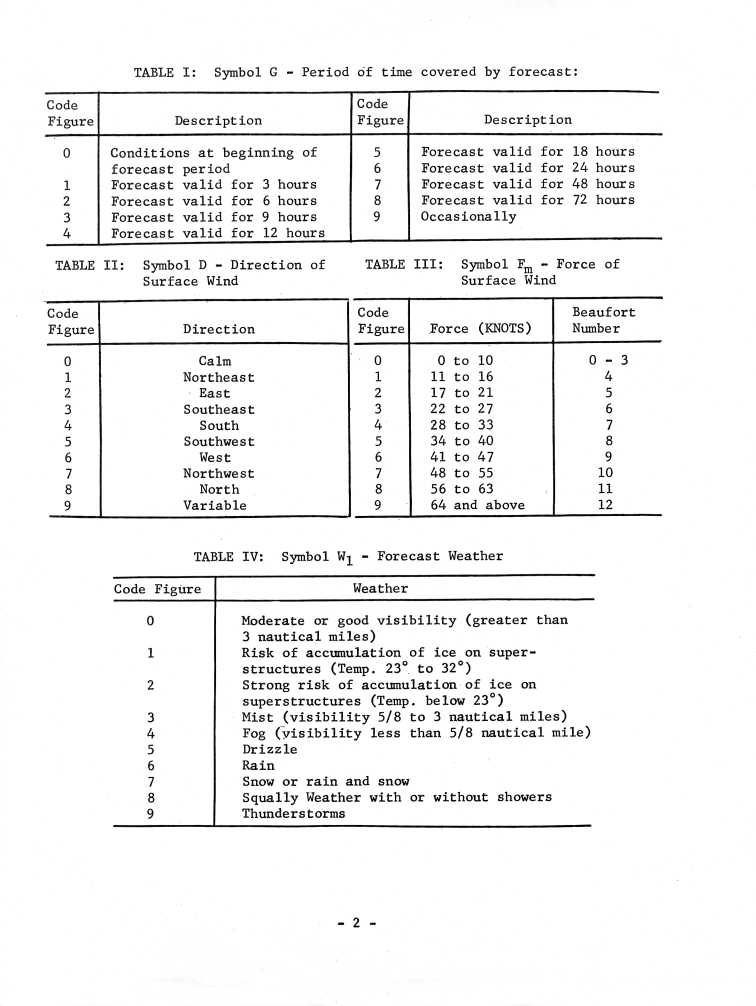
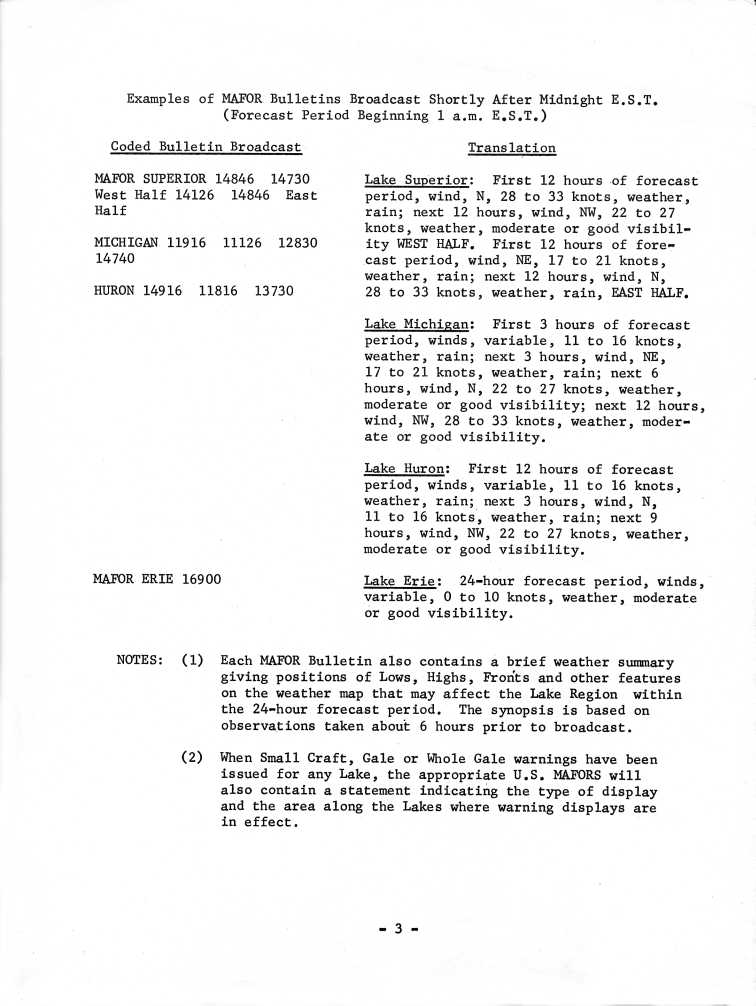
These stations' communications services to the boats included: 1) Various daily "Schedules" with all the boats of a given company's fleet where the boats reported in with their positions and other details of their operation and received "orders" from the home office, 2) "Phone-patches" to land-line telephones for both business and personal calls, and 3) Weather broadcasts. The weather and lake condition broadcasts ( LAWEB and MAFOR ) were an important, though non-revenue-producing, service provided by the stations. Here is a 1964 four page Weather Bureau bulletin detailing the MAFOR code system and broadcast schedule: Page 1, Page 2, Page 3, Page 4. From a little publication called Short Wave and Marine Band Guide here's more on MAFOR . William Hepburn has provided a truncated version of a LAWEB broadcast from WLC in the early 1980s. There is a silent period in the middle of the recording.
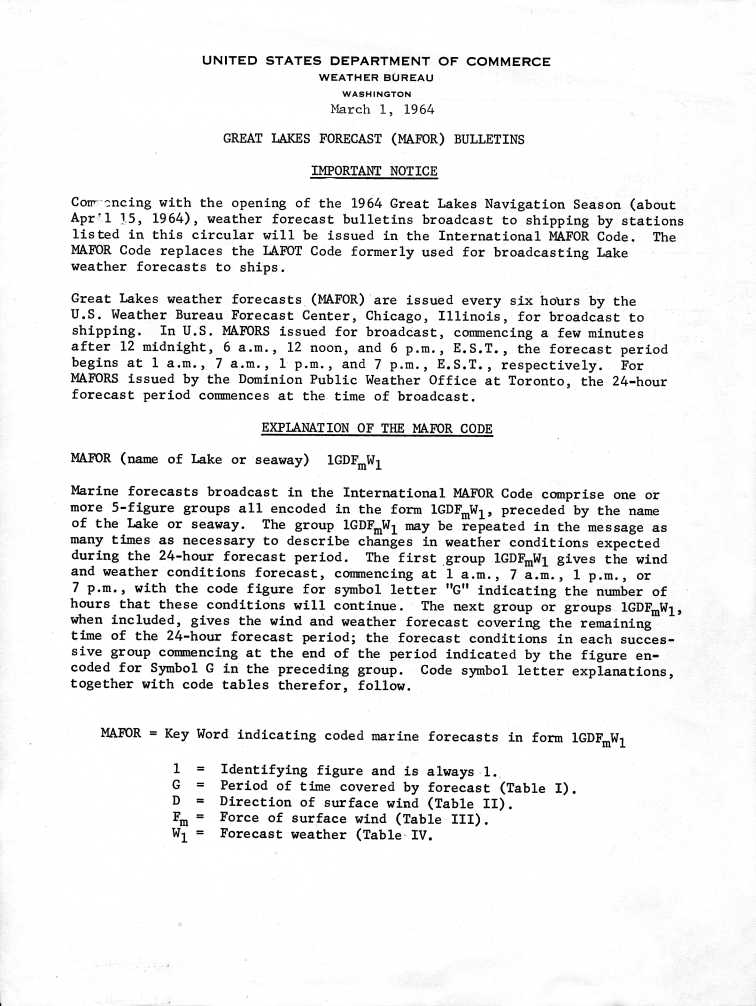
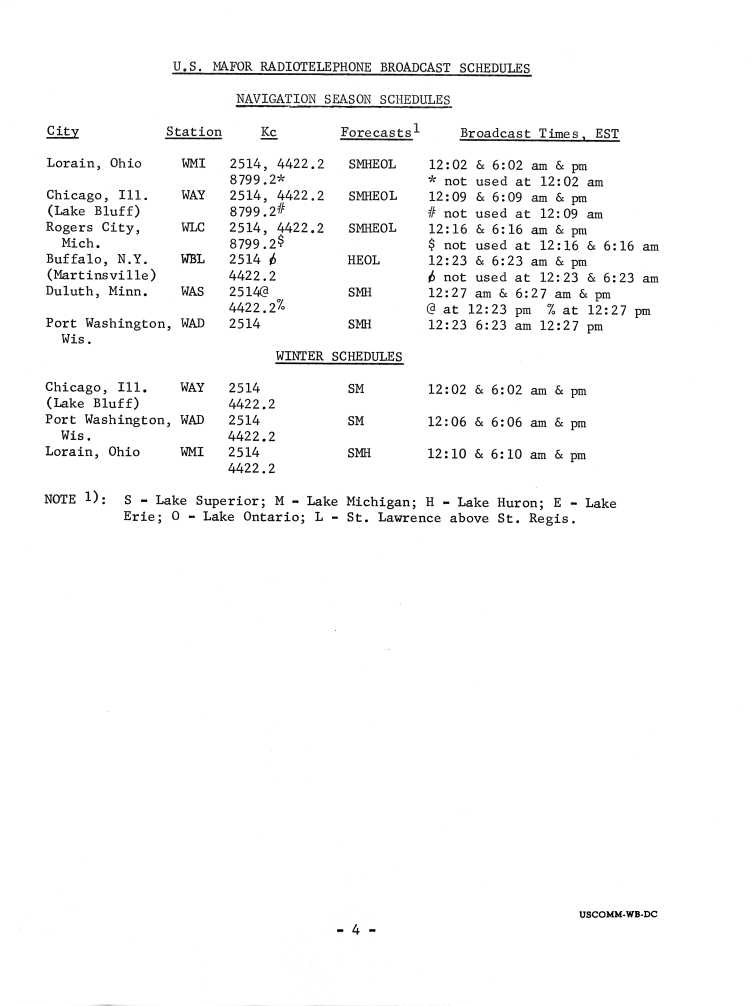
Great Lakes weather broadcast schedules during the 1959 navigation season were: WMI on 2514 and 4420.7 at 12:02 and 6:02 am and pm ---- WAY on 2514 and 4420.7 at 12:09 and 6:09 am and pm ---- WLC on 2514 and 4420.7 at 12:16 and 6:16 am and pm ----WBL on 4420.7 at 12:23 at 6:23 am and pm ---- WAS on 4420.7 at 12:27 and 6:27 am and pm ---- WAD on 2514 at 12:23, 6:23 am and 12:27 pm.
The Great Lakes can be just as dangerous as the high seas when the weather is stormy, and the reports of serious and sometimes fatal incidents "crackled" over the air-ways at times. Though the Coast Guard is the normal marine emergency communications agency, these commercial stations also handled a share of this type of traffic.
Six of the 11 stations that served the Great Lakes were authorized to operate on the 2, 4 and 8 MHz bands and thus were able to provide longer-range communications than the 3 stations that were only allowed to operate in the 2 MHz band. Each of the 6 stations (WAD, WAS, WAY, WBL, WLC and WMI) have individual pages on this site.
On November 8, 1939 the FCC authorized Thorne Donnelley doing business as the Donnelley Radiotelephone co. to construct a station (later licensed for 2550 and 2738 as WHC) at Mackinac Is, MI. The FCC also indicated that, once on the air, the station would be eligible to apply for special temporary authority to operate on 2182, 2514, 2572 and 4282.5.
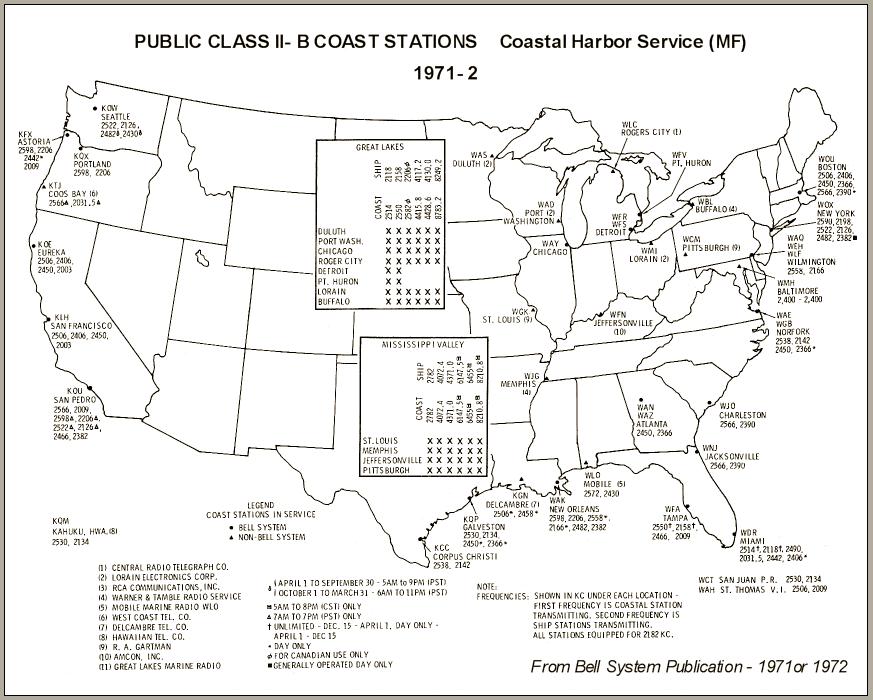
According to the 1971-2 AT&T map, the two stations in Detroit, WFR and WFS, and one station in Port Huron, WFV were restricted to the 2MHz band and thus provided only short-range service.
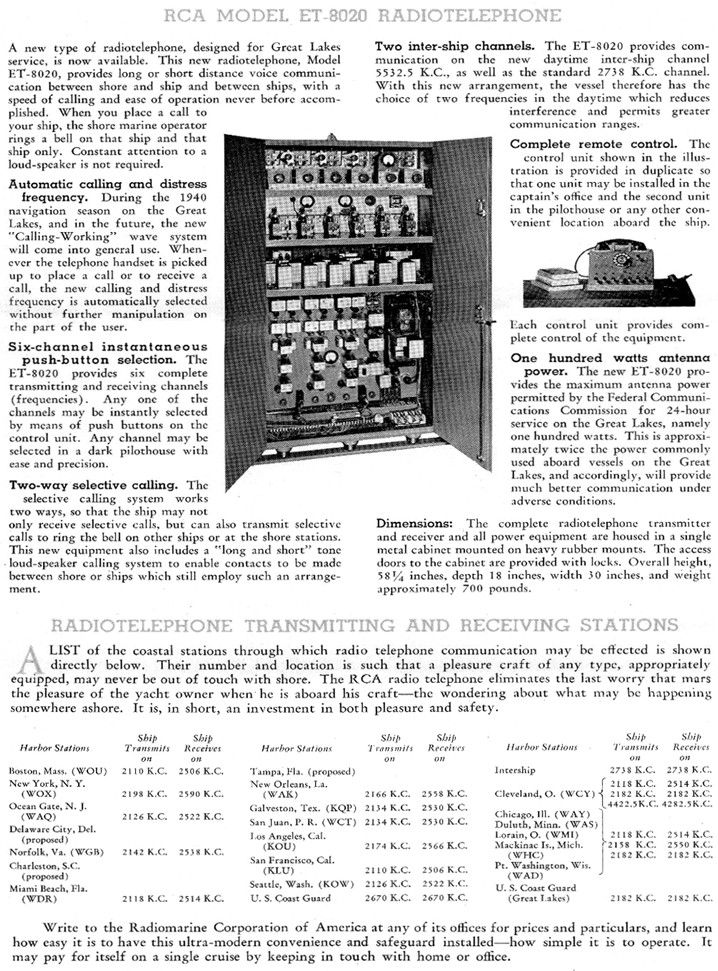
The June 30,
1941 FCC
Annual Report indicates that stations were authorized at Detroit, Port
Huron and Houghton, MI (Call
Letters ?). A table of radio telephone
stations at the bottom of this advertisement for the
RMCA ET-8020)
includes WCY at Cleveland, OH with 2 & 4 MHz
capability and
Thorn Donnelley's WHC at Mackinac Is, MI restricted to the 2 MHz band -
see the WLC page for more about this station. Information about
these MF
stations will not be actively sought but posting of any information
about them that is received will be considered.
Joe Papworth, K8MP has provided a copy (it's in PDF format - a 4.55Mb download) of the July 1947 issue of The Bulletin of the Lake Carriers' Association. This issue has two articles of interest. The lead article, "Crowded Airways" indicates that there were 14 radiotelephone stations serving the lakes in 1947. This is three more than indicated in the paragraph above. The second article, a "Common Sense View of Radar" begins on page 17. Tom Drake extracted two other radio related articles from K8MP's CD collection of the Lake Carriers Association's bulletins. The August 1949 Bulletin carries an article beginning on page 14 about the August 1, 1949 change-over of Channel 40< from 2738 KHz to 2003 KHz. The November 1951 Bulletin has an article beginning on page 13 entitled, "VHF Studied by LCA as Supplement to Present Radiotelephone System." This article has information about the channel designators for AM and FM that were in use at the time.
The FCC in its 1941 Annual Report indicates that frequencies above 3 MHz were assigned to the 5 Great Lakes stations licensed at that time (plus WBL?), but the FCC was very stingy with the allocations. All of the 6 longer-range stations shared three 2 MHz frequencies, two 4 MHz frequency pairs and one 8 MHz frequency pair. Later when the number of stations had diminished the sharing of the three 2 MHz channels continued, but each of the two remaining stations (WLC and WMI) had two exclusive 4 MHz and 8 MHz channel pairs - shared only with stations on the coasts or Caribbean.
The sharing of 2182 KHz between the rivers and the lakes was a problem. At night the ships on the Great Lakes were constantly hearing traffic from the towboats on the Ohio and Mississippi on 2182. Much of this traffic was associated with locking operations, but to the unhappy Great Lakes captains it appeared that 2182 was the frequency that the towboats used for all of their communications.
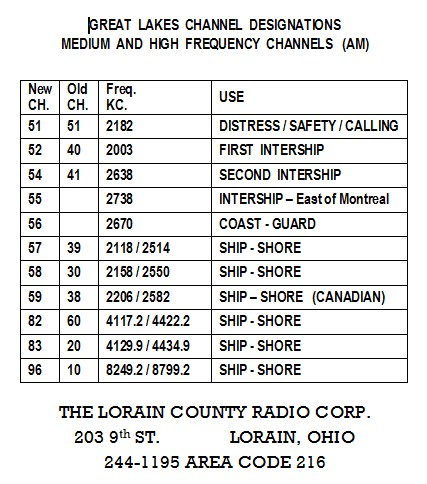 Mark Karney, N9JWF extracted the data in this table from a WMI document |
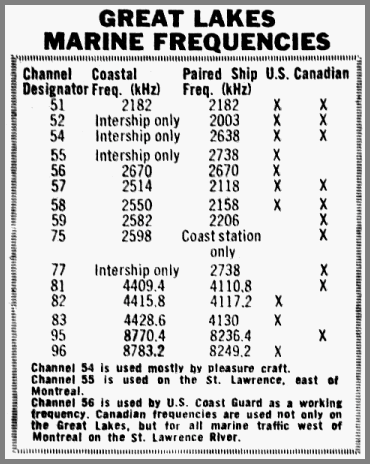 This table is from the winter 1971 Comm. World Magazine - Courtesy of Max Summerville, W8MMS |
|---|---|
Ian Marsh, G4EXD, has supplied the frequency information below for the Great lakes stations from the 'Admiralty List of Radio Signals', volume 1, for 1978. Read the details of his contribution here. WBL WMI Detroit Stations WLC WAY Canadian station links on this page.

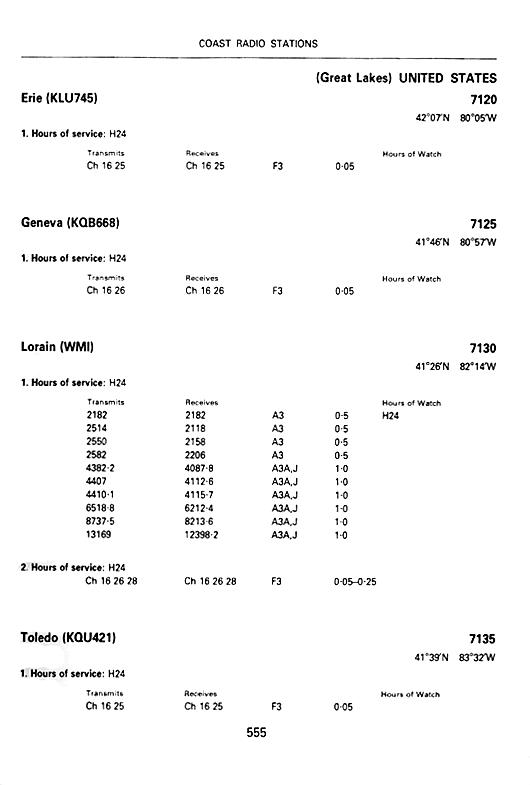
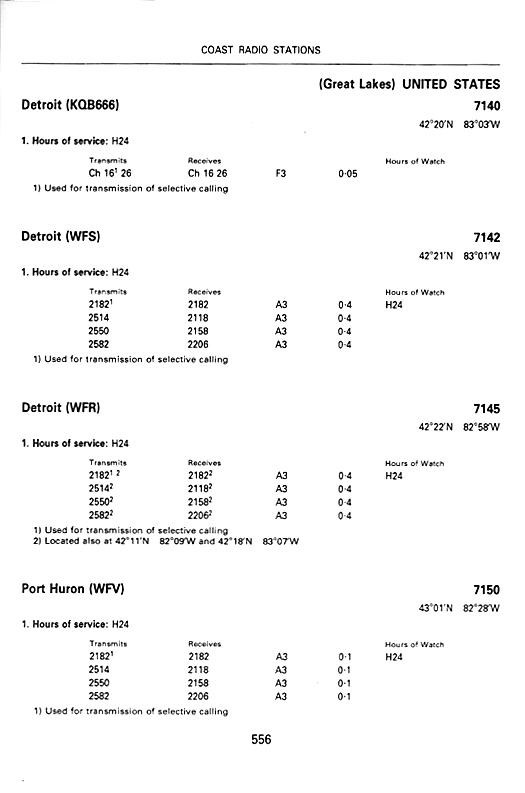

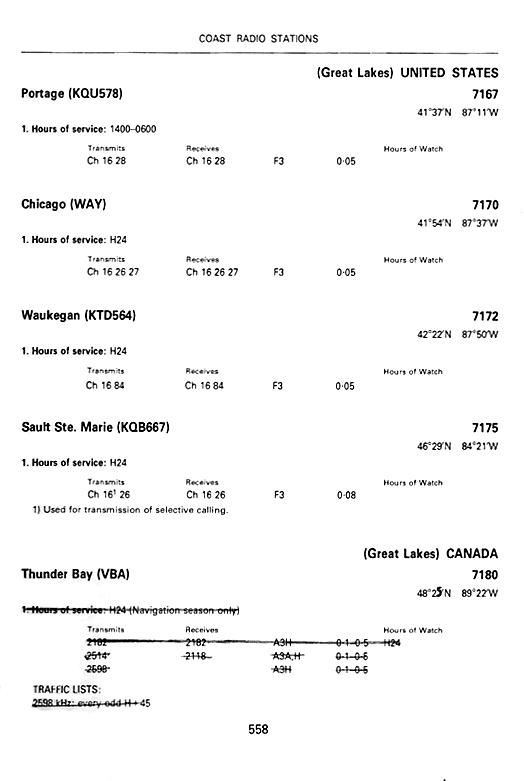
Here's
another list of channels from Charles C. Reynolds, a former Lorain
Electronics employee: The eight channels in Lorain gear were 51 - 2182
KHz - Calling and Distress, 52 - 2003 KHz, 56 - 2670 KHz - Coast Guard
liaison, 57 and 58 - semi-duplex 2 MHz band ship-to-shore
telephone
channels, 82 and 83 - semi-duplex 4 MHz band
ship-to-shore
telephone channels, and 96 was
a semi-duplex 8 MHz
ship-to-shore telephone channel. Here is a RMCA Frequency List. While the frequencies shown on these lists often agree, the channel designations often disagree.
Shortwave
propagation is less than 100%
reliable and, in addition, communications are often subject to static
degradation caused by the summer thunderstorms that occur during very
season when Great Lakes shipping is at its yearly
peak. This fact plus the availability of VHF-FM
marine communications equipment starting in the late 1940s led to the
slow evolution from HF to VHF. The first VHF-FM stations had
a range of 20-30 miles. However, (WFS ?) Detroit put a
VHF antenna at a high point hoping to capture traffic from Port Huron
to Toledo but there were lots of dead spots. With time VHF-FM
equipment improved and the development (in
the late 1960s, early1970s ?) of networks of
remotely controlled VHF-FM stations by both WLC and WMI greatly
expanded the coverage. The quality of the communications over
these new networks was vastly superior to shortwave SSB and its use
diminished greatly once the VHF-FM networks were in place.
Several correspondents have reported that there was much opposition by the Lake Carriers Association to the splitting of the VHF-FM channels from 50KHz to 25 KHz in the late 1960s. The Association even sued the FCC in 1969 to prevent the split. However, the FCC prevailed in court and the channels were split. The court record of the suit makes very interesting reading. It includes a listing of the VHF-FM channels in use on the lakes at that time.
This 1960 Allan Lytel book had a chapter about the status of radio communications on the Geat Lakes. Here's a copy of that chapter.
Two decades later satellite and cell-phone communications displaced the VHF-FM networks, and voice communications via the Great Lakes stations ended when WLC ceased voice operations in 1997.
Some old Great Lakes FCC ship callsign listings are reproduced here: US - FCC: 1931 4-Letter (Dept. of Commerce list) 1982 1992 Canadian: 1992
The date of this listing of U.S. Ship Callsigns is unknown, but must be prior to 1950 as all the callsigns are 4 letter.
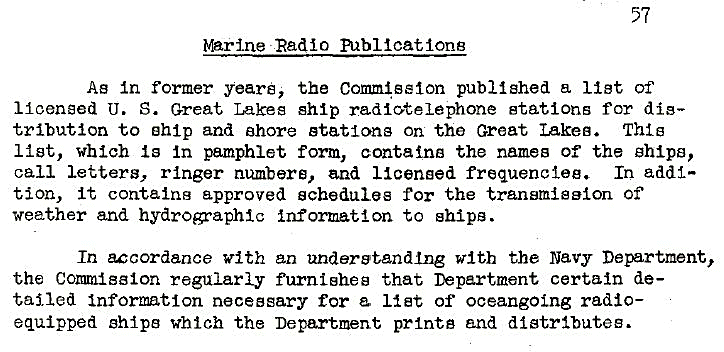
This quote from the 1944 FCC Annual Report gives one hope that there are old Great Lakes ship frequency lists out there to be found.
Here's a mid-1980s listing of the US and Canadian Great Lakes VHF marine Shore Stations.
Here is a list of the Great Lakes low-frequency radio beacon navigation aids that the Coast Guard once maintained. This Great Lakes Radio beacon Maps page has 1947, 1965 and 1985 versions of the Coast Guard's maps.