WFN
- Louisville, KY
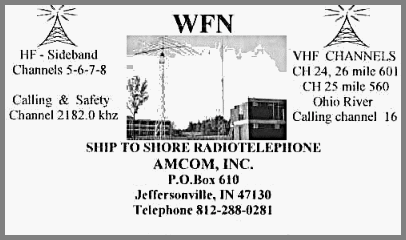
Here's
a
more elaborate WFN
Business Card
I remember hearing this Ship-to-Shore
station as a teenager in 1950. It was AM at that time and the
6 MHz frequency came in loud and clear in northern Indiana.
Though it was always called the Louisville station
as it was first located there, for most of its life it was actually
located across the river in Jeffersonville, IN.
Most of this material is courtesy of Paul
Hise who held many electronics-related positions with WFN and American
Commercial Barge Line (ACBL) and its parent company American Commercial
Lines (ACL). When Paul retired in 1992 after 26 years of
service he was Manager of Telecommunications for ACL.
The Early Years - Louisville and
Jeffboat
The
1944 FCC Annual Report contains the following statement: "A new station
at Louisville, Ky., established for communication with ships on the
Mississippi River and connecting inland waters, began operation with
service tests in June, 1944." WFN was established
by Warner & Tamble of Memphis Tennessee, also owners of WJG in
Memphis. However, Jack Estes reports that, while there may
have been service tests in 1944, Warner & Tamble was very slow
to fully activate the station. It was 1950 when he installed
the original Western 24B equipment at WFN and put it on the air. The original
station was at the Port of Louisville Terminal in Louisville,
Kentucky. The Port of Louisville Terminal was located at the
foot of Preston Street at River Road, just west of the I65 Kennedy
Bridge - see map below. (Anyone
have a WFN QSL card?)
It is
believed that the station originally operated only on a 2 and a 4 mhz
frequency. (However, note
my 6 MHz comment above.) The first
operator was George Meyer (perhaps
assisted by his wife?).
He continued
to operate the station until the Inland River crew strike in
(1958?). This strike shutdown most of the ACBL
operation. When the strike ended in (1959?) the station was
re-activated in an electrical contractors building on Poplar
level Road in Louisville by operator Roy Harmon. Roy was a
former radio
operator for the Corp of Engineers and an exceptional
operator. He had a good radio voice, was able to work well
and decipher the conversation in the worst of conditions, and had a
good rapport with the captains and pilots.
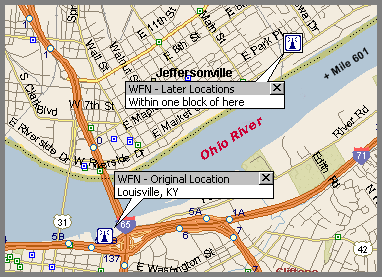 Early WFN
Station Locations - The Poplar Level Road location is not shown on this map |
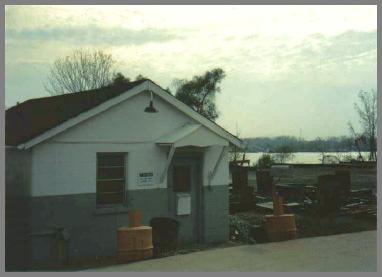 The Jeffboat WFN
building taken
years after the station had moved there -
Paul Hise Photo |
|
|
In (1959?) or (1960?) the station was moved
from the Poplar Level Road location to the Jeffboat shipyard in Jeffersonville, IN. At
this time the ACBL offices were also at the shipyard. Warner & Tambel had the small
concrete block building shown above constructed at the east end of the
shipyard. Two 60 foot towers were erected on the river side
of the building. Two multi-band off-center-fed wire antennas
were installed between the towers and building. One antenna
was a inverted V. At this time the communications media was
Medium and High frequency using amplitude modulation (AM) in the two to
eight megahertz band, The equipment was update to include a
refurbished World War II Western Electric 250 watt 4 to 12 MHz
transmitter and a RCA 8050 transceiver which was utilized as a guard
for the 2182 and 2782 KHz frequencies as well as backup for the 4 and 6
MHz frequencies. In addition, several RCA 8050 transceivers were purchased and the
receivers removed and utilized to provide monitoring of all available
frequencies. This
combination was controlled by a home brew multiple toggle switch remote
console setting on a used U.S. Navy grey metal desk. A large
back-lighted Raytheon advertisement clock provided the time.
An eighteen inch window fan in the front window air-conditioned the
building.
Paul started work at WFN on a part time
basis from April to August of 1962. At that time the normal
work hours were 6 to 6 Monday through Saturday and 6 to 1 on
Sunday. Mr. Harmon had worked this schedule consistently over
the years except for a few days off when WJG would operate the schedule
from Memphis. In November of 1965 Paul, who was then
working for the Indiana State Police, was offered a full-time operator
position with ACBL by Captain Jack Wofford, ACBL Vice President of
Operations. Roy Harmon had taken another job, and an operator
was needed for WFN. Since Warner and Tamble then owned the
station, Captain Wofford indicated that ACBL intended to purchase the
the station from them if Paul would take the job. Wofford
also indicated that ACBL was in the process of expanding its fleet and
operation, and the advancement prospects within the company were
good. Paul accepted the offer and began working on January 1,
1966.
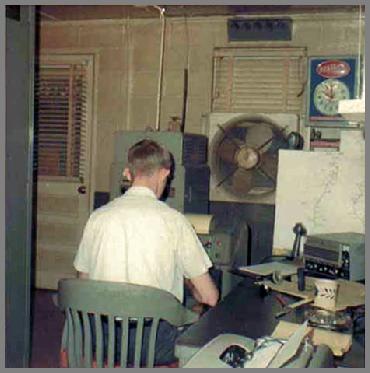 Paul Hise in the
WFN Jeffboat
Operating Room |
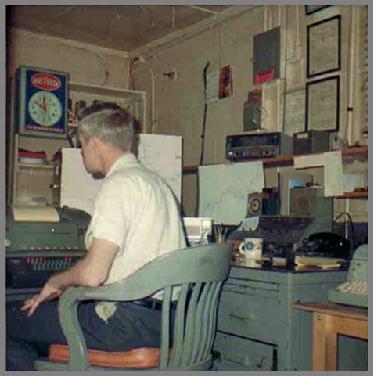 Both Photos by
Paul Hise - 1966 |
|
|
WFN operated under Amcom, Inc. a wholly
owned subsidiary of American Commercial Barge Lines. As a
Marine Public Coast Radio Station WFN was required to connect any
telephone in the United States with any boat equipped to communicate
with the station; but, in practice, it primarily served ACBL/ACL
boats. Four schedules were called each day between 6 AM and 6
PM Monday through Saturday and 6 AM to 1 PM on Sunday. These schedules
were for twenty to thirty boats, STEPHEN F. AUSTIN, LASALLE, RAYMOND E.
SALVATI, PHILIP SPORN, SPENCER, PAT CALHOUN, JR., GIBRALTER I and
TRADEWINDS to name a few. Boat orders were sent to the
Station by landline teletype between schedules. During
schedule time the teletype was used to record the boat traffic on line
to the ACBL office. A paper teletype tape was cut for
retransmission to provide multiple schedule copies for distribution to
office personnel. The time between schedules was utilized to
receive boat grocery orders to be forwarded to a boat store, to
complete ship to shore radio/telephone calls, maintain the equipment at
the station and at times to provide electronic maintenance to boats in
for repairs at the shipyard.
1965
to 1976 - SSB, New Location and Station Upgrades
VHF-FM
service at Jeffersonville (OHR mile 601) was established in 1965
utilizing Calling Channel 16 and Channel 26. In 1969 Channel
24 was added at Jeffersonville and an additional remotely-controlled
VHF station on channel 25 with a separate channel 16 calling channel
was activated at Madison Indiana (OHR mile 560). Later, after
the 1973 tornadoes, this station was moved across the river to Milton
Kentucky, still at mile 560.
In early 1967 experiments with high
frequency sideband radio were undertaken, and plans were developed to
relocate the station to a new building and facilities.
Operations began in the new facility at 1700 East Market Street in
December 1967 - Press
Release. This new WFN building was constructed to
be waterproof and operational during floods. The upper floor was about
1 foot above the 1937 flood level. All electric, telephone
and antenna feeds were waterproof. A new 1000 watt Single
Sideband Transmitter, state of the art receivers, VHF-FM transceivers
and a custom designed control console were the heart of the
operation. Antennas on the 12 acre site included a new
half-wave dipole antenna for each frequency band and seven towers from
60 to 90 feet tall.
By 1967 the number of schedules called
each day had increased to 5 as shown on this Position
Schedule Sheet. Both companies shown on this sheet
were ACL subsidiaries. By 1982 this was up to 6 schedules per
day. The station went to a 24 hour schedule in 1968, first
just the VHF-FM and then in 1969 with HF. Station managers in
this time period were Roy Harmon from August 1969 to March 1973 and
Robert Grau from July 1973 to September 1974. Here, couresy
of Jeff Yates, is a 1968 WFN
QSL card .
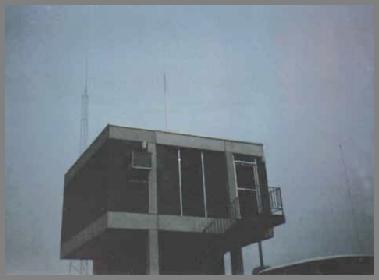 1700 E. Market St. - The flood-proof WFN home from 1967 to 1974 -
Both photos courtesy of Paul Hise
|
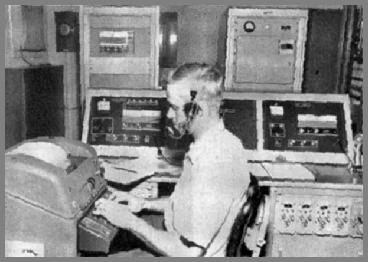 Paul Hise in the new 1700 Market St. operating room in 1967 - Two
new Karr VHF-FM transceivers in the console - A new Karr CH-25M
SSB TX in the left rack - Four new Karr SSB Receivers at the lower
right. The old WE AM TX in
the
right rack? |
|
|
In August of 1969 Paul was offered, and
accepted, the job of Marine Electronic Technician by Captain Jack
Bullard, ACBL Marine Superintendent. Bobby Gloyd who had held
this job since 1965 had accepted another position. Paul also
continued to supervise WFN’s overall operation with Roy Harmon, who had
returned as an operator at WFN, managing the day to day operation of
the station.
In 1974 a 1600 sq. ft. two-story addition
was added to the WFN building. The top floor was to
accommodate the expansion of WFN's operating positions to 3 positions.
The lower floor was the new electronic repair facility. This
addition compromised the flood-proofing to some extent as an emergency
generator on the back platform was 7 feet below the 1937
crest. However, the original feeds remained
waterproof to the upper floor.
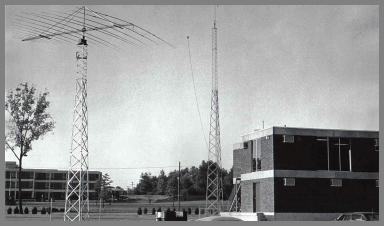 The 12 acre 1700E. Market St.
site in 1976 after the building addition. Five ROHN self-supporting towers
supported individual center-fed dipoles for the 2-4-6-8 MHz bands. A 70 foot tower topped
with the VHF-FM antenna served as a vertical grounded Marconi antenna
for the 2182KHz emergency frequency - The 6-30 MHz log-periodic antenna was
added to better cover the Gulf Intercoastal Waterway - ACBL Hq. building in the background.
|
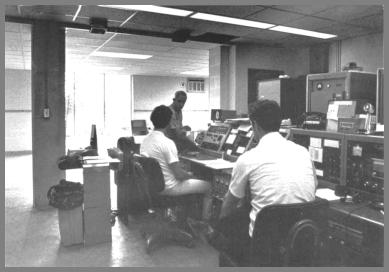 The new WFN Operating Room in 1974 - Pictured front to back are
Operator Bob Grau, Phillip Covert, and Chief Electronic Engineer Paul Hise
- Both Photos by Paul Hise. This Article, from about the same time, has photos of 7 members of the WFN staff.
|
|
|
|
|
During 1973-4 when
Robert Grau was the Station manager WFN conducted tests of Radio
Teletype as a means of communicating with the towboats. Here
is
the report to the FCC
on those tests.
1976
- The Elizabeth, IN Site
Unfortunately, soon
after the building expansion was completed the electric utility company
upgraded its primary feed line along Market Street to 167000 Volts.
This new line produced considerable low frequency RFI marginalizing
WFN’s reception on most frequencies. This interference
required the relocation of WFN’s main transmitters, receivers and
antennas. The construction of a new remotely-controlled
station on a 60 acre site 15 air miles west and north of the Ohio River
near Elizabeth Indiana off SR11 was undertaken.
At the Elizabeth site a 20 x 30 foot steel
insulated building was constructed, and new CIA transmitters and
receivers were installed feeding two directional TCI wire log periodic
antennas. The smallest, a bi-directional oriented within 5
degrees of east and west to provide coverage for the Ohio, Upper
Mississippi and Illinois Waterway, was installed on a 132 foot guyed
tower. The other TCI wire log-periodic, covering from the
station south to Mobile, AL and west to Brownsville TX, was constructed
over a 225 foot guyed tower and with the adjacent catenaries took up
nearing five acres. In addition a Hy-Gain 6 to 30 MHz. log
periodic was installed on the 150 foot microwave tower and positioned
to provide additional coverage to the Upper Mississippi and Missouri
Rivers. Here's an image of a 1977 Towboat
Tribune article with some pictures. This remote
site was operated and controlled via a 2 GHz. Farinon microwave system
from the ACBL building at 1701 E. Market St.
Backup generators were installed to allow continuous
operation. This remote site became operational in the fall of
1976, Perhaps all WFN
operations at the 1700 E. Market St. building were terminated at this time?
The Later
Years - SSB and Beyond
During
the period from
1968 to 1976 Sideband and VHF-FM transceiver installations were
completed on all ACBL boats. A new towboat construction
program was initiated using the newest electronic and navigation
equipment. The first duplex analog data communications were
conducted between WFN and the M/V BILL ELMER on the Mississippi River
utilizing frequencies in the 6Mhz band. In 1980 the
developmental data radio system was completed and the first digital
data communications were transmitted between the station and the M/V
SONNY IVEY utilizing VHF frequencies. Here's an image of a 1980 article
with more detail on this.
WFN station managers during this time
period were: Harold Mauck from 1975 to 1980 and Lemuel Greer from 1980
until his retirement in 1988. Here are images of a
three page article from early 1982 that give more detail on the
station's operation and personnel at that
time: Page 1
Page 2
Page 3
Early in 1987 the WFN operating consoles
were redesigned and the WFN operating positions were moved to 453 E.
Park Place just north of the ACL building. The new consoles
used telephone switching technology to operate the station and provide
enhanced ship to shore telephone calls.
In 1991? Paul Hise wrote Communications Journal -- One Quarter Century this was page 5 of an issue of ACL's internal publication.
It would be nice if more were known about the winding down of WFN. When did
WFN cease operation on HF, and decommission the Park Place operating
consoles and Elizabeth site?
The WFN replacement was WATERCOM an automated system serving the inland rivrs. There was a similar automated system on the Great Lakes. See the
WMI-VHF page.
Some of the WFN
Crew and their recollections.
