Pittsburgh,
PA and Cincinnati, OH
The June 30, 1942 FCC Annual Report
states, "Public hearings were held on applications for construction
permits for similar new coastal harbor stations at Pittsburgh, Pa.
---." The FCC Annual Report dated June 30, 1946 indicated
that a new coastal Harbor station had been established (authorized?)
during the fiscal year at Pittsburgh, PA. However, Jack Estes
reports that Warner and Tamble (WJG) obtained a license for a station
at Pittsburgh in the 1940s, but took no action to put it on the air and
about 1950 relinquished it in favor of RMCA. The
1951 FCC Annual Report states: "Public coast stations were authorized
at Pittsburgh, Pa., and --- ." The station was
constructed started in the summer or fall of 1950 and
completed during the 1950-51 winter. This 1951 RMCA ad mentions
WCM as a new station. Since
WCM was an RCA station it had a maritime
tradition and all messages intended for everyone to read were titled,
"All Hands."
Over the years WCM had three
owners: RMCA from 1951 to 1967, Ray Gartman (Owner of
high-seas station WLO, Mobile, AL and also of WGK, St. Louis, and WJG
Memphis for a
time) from 1967 to 1974, and Midland Enterprises (parent of the Ohio
River Company,
ORCO, one of WCM's major customers) from 1974 to 1995. The
1971, and later, ATT Maps
show Gartman as the WCM
owner.
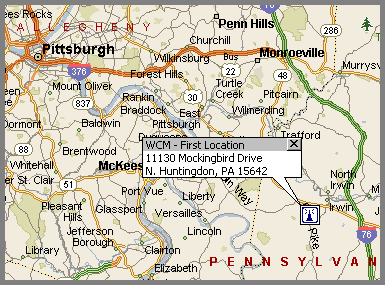 1951-1983 |
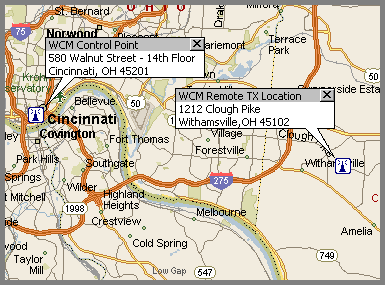 1983-1995 |
|
|
WCM - PITTSBURGH
This
Ship-to-Shore station, located
about 17 airline miles southeast of the city of
Pittsburgh,
was originally
installed and owned by RCA's Radiomarine Corporation of
America. The builder of the station and its manager
during many of the RCA years was William N.
Hayton. Through
the courtesy of ex-WCM operator Gary
Hummell, N3YEX, who had the foresight to save some of the
nostalgic
items from the WCM Pittsburgh files on the station's last day of
operation there on April 15, 1983, we have a great series of
photos
showing WCM's beginnings. Many of these photos are dated July
1951, but since many show snow on the ground and the trees are bare
some were obviously taken the winter before.
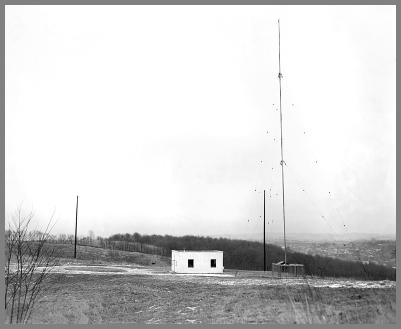 The new WCM - Looking Approximately East - Winter 1950-51
|
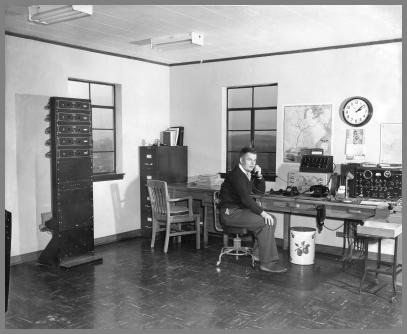 Bill Hayton at WCM - 1951 |
|
|
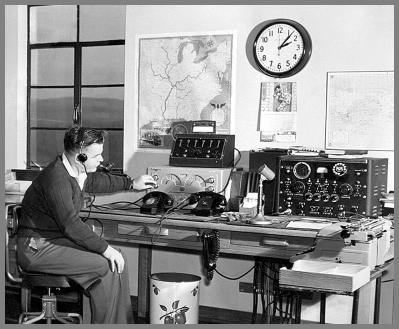 Bill Hayton operating WCM - 1951 |
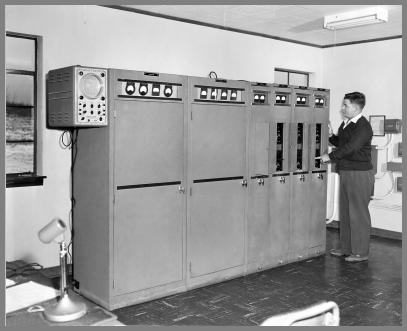 The original WCM main AM transmitter - A Wilcox 96C |
|
|
|
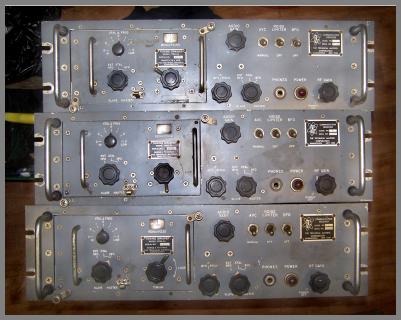 TMC
fixed frequency AM Receivers - EX WCM Pittsburgh
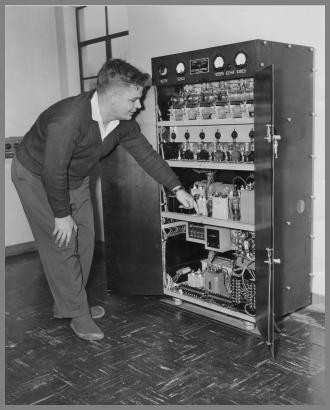
Left - Bill Hayton with the WCM
Aux. AM Transmitter - A Model TDF (Made by RCA?) - 1951 |
|
|
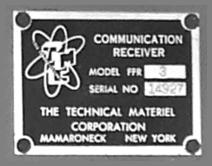
|
<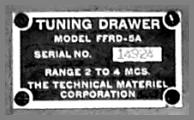 Above and Left - Nameplates on the TMC receivers |
|
|
Many additional photos of the
construction
and beginnings of WCM can be found on the WCM
Photo Page.
In
the 1950 to the mid-1970s time period WCM
used the
following AM equipment:
Transmitters: Main TX was a
Wilcox Model 96C (shown above). It had two 450-TLs modulated
by two 450-TLs. There
was a RF deck for each MHz range (2, 4, 6 and 8 Mhz) and each deck had
its own
pair of 450-TL tubes. The modulator and power supply (on the
left end) were
common. The Stand By TX (shown on the WCM Photo Page) was a
Model TDF (Made
by
RCA?). It used a pair of 813s modulated by a
pair of 813s.
Receivers:
Fixed-channel units (8) by either RCA or Technical Material Co. (TMC)
to cover two 2 MHz, two 4 Mhz, two 6 MHz and one 8MHZ channels with one
spare unit. The RCA and TMC receivers were similar with
plug-in (from the front panel) rf/oscillator sections so the
unit's channel could easily be changed by changing the heads.
Console tunable receivers: RCA AR 88 and Hammarlund SP-600JX.
In the 1951 pictures there is a rack of 5 receivers of an
earlier vintage, and the tunable receiver on the table appears to be a
National NC-183.
Antennas:
A multi-frequency tuned 84 foot vertical which is shown in many of the
photos. Flat top dipoles
for 4 and 6 and 8 MHz. These must have been installed after
the
initial construction as they don't show in any of the 1950-51 photos.
There was a long-wire (400 Ft) receiving only
antenna (which
may be the antenna between the 2 telephone poles in the photos?)
Most station control and
switching units
were "home-brewed" by WCM operators.
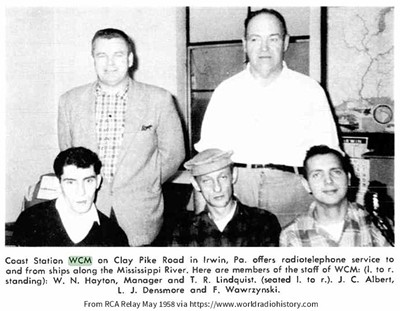
WCM Crew - 1958 |
This RMCA Advertisement is from the little 1955 Great Lakes Redbook.
According to operator Dave Zibrat, who was there in the
early 1950s, WCM got the very first experimental SSB unit on the
river system for testing. They had to rely on those boat captains who
knew how to use a BFO to receive WCM's SSB transmissions for the tests.
See below for more about SSB coming into full use for marine
communications in the late 1960s.
The next paragraph, from The RCA Engineer, April-May 1956, Page 19 - via worldradiohistory.com gives more detail about the SSB tests.
|
|
|
In June 1955, the SSE-l was installed on board the M/V VALVOLINE, a river tow boat, owned and operated by the Ashland Oil and
Refining Company. C. E. Schneider of Radiomarine operated the equipment on the vessel during a run on the Ohio River between Ashland, Ky. and
Mt. Vernon, Ind. Traffic was worked through station WCM in Pittsburgh. The SSE·l consistently outperformed the 150-watt transmitter at WCM and
under conditions of interference and atmospherics outperformed the 1000· watt station transmitter. The absence of selective fading effects with
accompanying distortion of the received signal'was especially gratifying when using single sideband. The SSE· 1 operated very satisfactorily
under the heavy vibration conditions present on board the diesel-driven VALVOLINE. Frequency stability proved excellent, with no distortion
evident due to drift effects.
During the RCA years there was
a pink RCA
form that was
used for all messages going to the boats, and another, almost identical
pale yellow one, for the ship-to-shore messages. Probably
these
were generic forms that were used at all RCA
stations.
At WCM they were kept for all communications and
sent to RCA in New York at the end of the month for billing.
The
outgoing forms actually had the complete text of the message.
The incoming ones were gernerated during
the scheduled communications with the boats and contained
only the vessels position at the time of the communication.
All positions were given in the following form; for example:
473 North Ohio or 473 NO. This meant the boat was at 473
river miles from Pittsburgh (mile zero on the Ohio) and was heading
upstream. On the rivers upstream is North and downstream is
South. It has nothing to do with compass direction.
On incoming messages the signature was always "Master".
This
was probably another high-seas carryover as the top guy on a
towboat is usually referred to as "Captain".
When Ray Gartman purchased the station in
1967 Bill Hayton and two of the operators left to take other positions with
RCA. Hayton retired as station manager at KPH on the west coast. He died on Oct. 4, 1980.
There is more about Hayton's time at KPH on the MRHS site. Two other crew
members managed the station before Frank
Deedrick became manager in 1968. Under Gartman's ownership
the conversion to Single Sideband (SSB) started. For a few
years during the changeover WCM operated both AM and SSB - the existing
AM equipment, along with various sideband units under test.
In 1974 Gartman announced that WCM was for
sale and that if there were no buyer the station would be
closed. There was no outside interest in the
station. A partnership was formed by Deedrick, and operators
Lindquist and Kelly to try to buy the station.
However, the others soon opted out leaving Deedrick as the only one
interested. He soon found an "outside" partner in Merlin J.
Pitts. Pitts was not a real outsider since he had been a
marine radio/radar repair person for many years. However, at
this time the FCC required that the station immediately finish
converting to SSB. The additional SSB conversion costs caused
Deedrick and Pitts to abandon the purchase attempt.
Enter,
Cincinnati based river transportation company, Midland Enterprises
owner of WCM’s biggest customer the Ohio River Company
(ORCO). In addition to the ORCO traffic, WCM
handled the traffic for all of Midland's other subsidiary
companies (also for Dravo-Mechling and Ashland Oil). Since
WCM was important to Midland, and since they did not want to find
another form of communications, they decided to buy the station and
continue operating it as a public correspondence station. The
purchase was made in 1974, and the conversion to SSB was finished under
Midland ownership.
At that time the technical
lineup was Northern Radio Co. transceivers for each channel and 3
switchable Northern Radio linear Amps. The monitor receivers
were Communications Associated Inc. (CAI) for each channel.
Additionally, the vertical antenna was replaced with a Hy Gain 6 to 30
MHz. seventeen element rotatable log-periodic array on a 75 ft.
tower. As with the earlier AM installation, all switching
consoles were "home-brewed" by WCM personnel.
WCM also operated a VHF-FM
public-correspondence marine station using GE Mastr Pro line equipment
on channels 16 and 26. The down-river range was increased by
adding remotely-controlled station KLU-836 at Freedom, PA (Ohio River
Mile 23.5 - near the most northern point on the Ohio River) also on
channel 16 and 26.
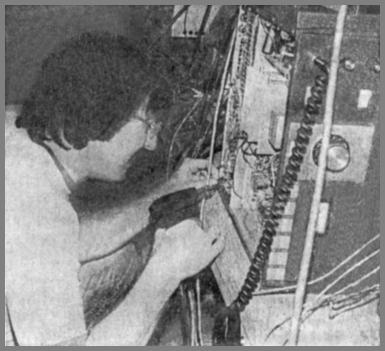 Frank Deedrick
Repairing Equipment |
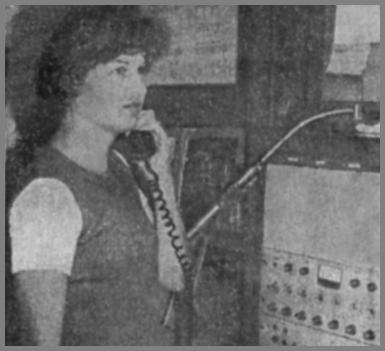 Clerk-Operator
Gloria Miller
-
Jeannette News-Dispatch Photo |
|
|
After the 1974 purchase operation
continued at the Pittsburgh location for about 9 years with Frank
Deedrick managing in the early years, and Tony Garofalo coming on board
as manager in 1979 when Deedrick left. The station maintained
a 24 hour daily
schedule every day of the year, and used this message format .
There were 2
daytime operators (and a clerk-operator on weekdays) and 2 operators
splitting the evening and overnight hours. The photos above
are from a 1975 newspaper
article which gives more information about the station at
that time. Also in 1975 Associate, the company
magazine of Eastern Gas & Fuel
Associates, the parent of Midland, carried a three page color pictorial
article about the station's
operations. Page
1 - Page
2 - and Page 3 are
full-size images of the article.
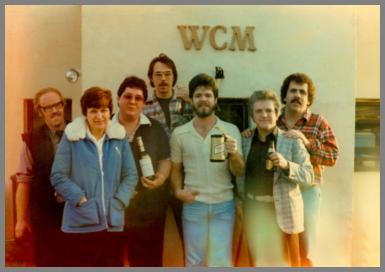 The WCM Crew - Christmas 1979 - Left to right
Carl Ewing (Part time) - Gloria Miller - Tony Garofalo - Gary
Hummell - Don Inks - Bill Morgan - George Moreland |
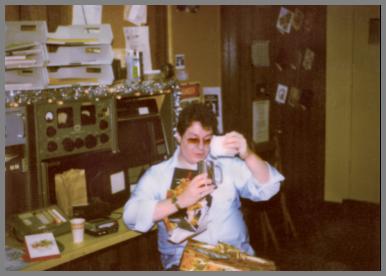 WCM Manager T. Garofalo at the WCM Console -
Christmas 1979 - Both Photos Courtesy of Tony Garofalo |
|
|
In
1982 the advantages of co-location with Midland's main office and of
Cincinnati's more central location which offered better coverage of all
of the inland rivers, particularly the lower Mississippi, prompted a
decision to move the station to Cincinnati. FCC permission
was requested and received, and the move was made in 1983.
Pittsburgh went quiet and Cincinnati came alive at 23:00 on April 15,
1983. When WCM moved to Cincinnati the Pittsburgh and
Freedom, PA VHF-FM operations were maintained for a few months and then
sold to another VHF marine station operator.
WCM -
CINCINNATI
The new
Cincinnati station was built by
personnel from ITT-Mackay Marine, and Chuck
Reynolds provides some detail in his recollections.
The new station utilized extensive redundancy to help assure reliable
operation. There were 2 main control consoles located at
Midland's headquarters on the 14th floor at 580 Walnut Street in
downtown Cincinnati (Ohio River Mile 470.4). Six leased
telephone lines connected the control point with the remote receiving
and transmitting equipment on a two acre site in Withamsville, OH some
15 airline miles to the east. The station listened for calls
simultaneously on channels 4, 6, 8, 12 and 16 via a rooftop antenna (just one? and what type?)
and 5 CAI crystal controlled monitor receivers at the Walnut Street
location. There was also an ICOM R71-A tunable receiver used
as a backup for any malfunctioning CAI receiver. There was no
transmitter at the Walnut St. site, and all transmissions were made,
one frequency at a time, from the Withamsville site. To
protect the equipment one set was completely shut down during
thunderstorms. Also see this 1992 WCM
QSL letter for more information about the station.
Except for Tony Garofalo none of the
Pittsburgh staff transferred to Cincinnati. Five new
operators were hired, and given 2 weeks intensive training prior to the
April 15 switchover. Tony practically lived at the station
for 4 months until the new operators became sufficiently
proficient. The new WCM became the Communications Center for
Midland, integrating the company's Cincinnati HF utility station WXZ354 and
their local VHF-FM marine utility station (Call
letters?)
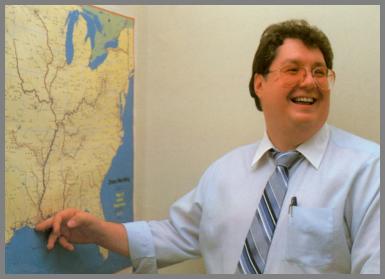 Tony Garofalo
at the inland rivers map
Eastern
Gas & Fuel Associates photo by Gary Battiston |
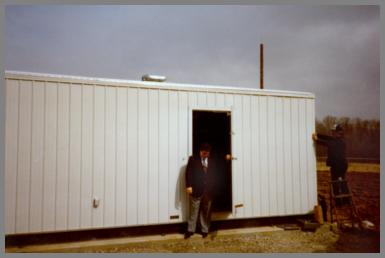 Tony Garofalo
at the new Withamsville
site in early
1983 -
Tony Garofalo Photo |
|
|
WCM maintained two schedules each day
at 07:00 and 13:00. The 1992 inland River Record lists 84
Midland boats, and all were contacted at these times. They
reported their positions and other pertinent data and received the
orders which governed their operation until the next
schedule. Additionally, the Dravo-Mechling boats also had a
19:30 schedule just for receiving orders. The text of this 1984 article in
Associate, the company magazine of Eastern Gas & Fuel
Associates, the parent of Midland, reports on the station
operations at it's new Cincinnati location.
With its Midland schedules WCM utilized a
list of approximately 70 two-letter codes to speed up communications
and simplify the task of entering (typing at the station and
handwritten on the boats) the information which was transmitted by
voice over the radio channel. It was a very efficient
system. Years ago (when I was an active listener to WCM which
was the strongest towboat or laker station for me in North Carolina),
Tony Garofalo graciously sent me a copy of the WCM code
sheet. I rearranged the codes in alphabetical order and
combined them with some of WCM's river designator codes that I had
obtained by phone from one of the WCM operators late one
night. Here's my one-sheet
version of those codes.
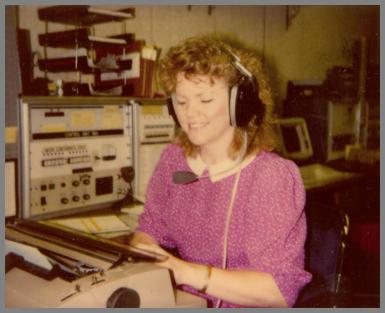 Ann Kamp copies
traffic at
WCM - T.
Garofalo Photo |
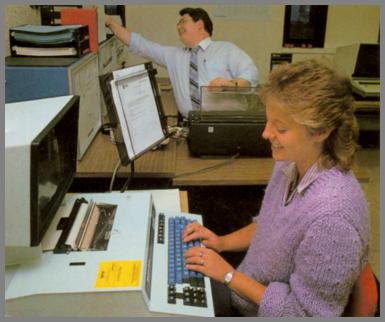 Pam Counts
inputs data into the twx
machine Eastern
Gas & Fuel Associates photo by Gary Battiston |
|
|
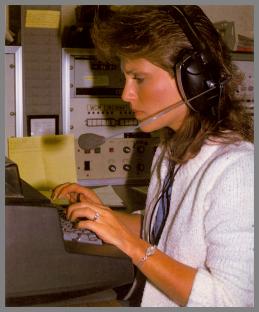
Diane Kathmann enters traffic being received from one of the towboats. Eastern
Gas
& Fuel Associates photo by Gary Battiston
|
A unique thing about WCM was its use
of a 12
MHz channel which was mostly used to contact the boats of Midland's
Orgulf and Red Circle subsidiaries operating in the Gulf of Mexico
towing between the Intercoastal Waterway ports and Tampa. I
never heard any of the other inland marine stations on their authorized
12 MHz channels.
WCM was also authorized to operate on a
never used 16 MHz channel which, nevertheless, had to be monitored for
calls as required by the FCC license.
|
|
|
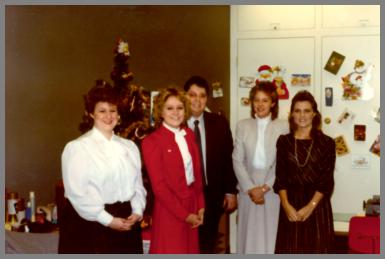 WCM Christmas
Party - Left to right:
Jeanne Rose,
Trish Dow, Tony Garofalo, Pam Counts, Diane
Kathmann - Tony Garofalo Photo |
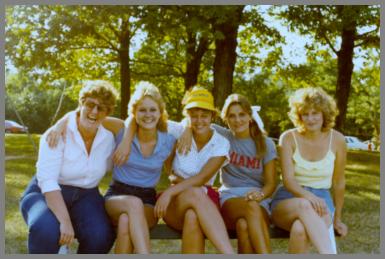 WCM Operators
Picnic - Left to right:
Jeanne Rose, Trish Dow, Pam Counts, Diane Kathmann, Diane
Holman - Tony Garofalo Photo |
|
|
With new communications options
developing,
both Ashland oil and Dravo-Mechling eventually made other arrangements
for communications services, and after the early 1990s WCM was
providing service only to Midland boats. In 1989 Midland
started to make some use of the communications services provided by
Watercom and also, about this time, began planning to put PCs in the
pilot houses with satellite data and voice
communications. By 1995 the boats had operational
PCs and satellite communications service provided by American Mobile
Satellite Corp. This new capability combined with
Watercom (which was used until about 2001) and the growing use of cell
phones on the towboats led to a decision close WCM rather than move it
from 580 Walnut St. to the new Midland headquarters location in the
"Book Building." WCM surrendered its license and
ceased operation on May 31, 1995,
After WCM went off the air the WCM crew
continued operating the Midland Communications Center. Prior
to WCM's closing the towboat captains had been furnished with a
document detailing alternative communications options and costs
including, Satellite, WFN, WATERCOM, and VHF
public-correspondence marine stations, and much of this
communication continued to flow through the Communications Center.
See the WATERCOM page for details about that system.
POSTSCRIPT
Midland was to last only a few years after
the closing of WCM. In 2002 Midland was sold to Ingram
Industries (operator of Ingram Barge Line), and during the next two
years Midland's operations were integrated into Ingram's, and Midland's
Cincinnati headquarters was substantially eliminated with the
Communication Center closing on April 11, 2003. Ingram sold
off some of the smaller Midland subsidiaries, retained and renamed
ORCO's bigger, newer boats and sold the smaller, older boats to other
operators. On May 19, 2004 Ingram announced that ORCO would
cease to exist. Nothing about radio here, but these 2 Articles detail the sale and provide some ORCO history. A detailed ORCO history, "The Rise and Fall of a River Empire," is in the March 2020 Issue of the S & D Reflector
Some of the WCM crew and their
recollections.
