
Recollections of Robert Ballantine, W8SU
THE STANNARD ROCK
INCIDENT
OR ASSISTING AT THE LONELIEST PLACE ON EARTH.
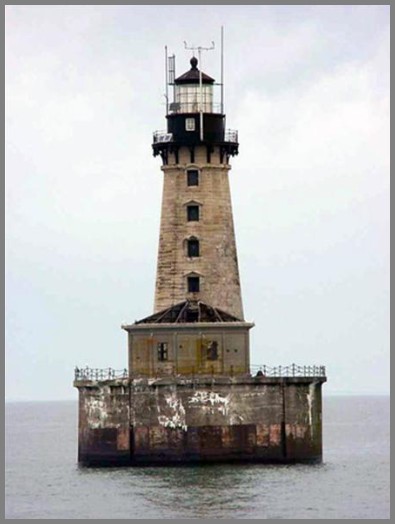 Stannard Rock photo by USCG |
The year was 1961 and your writer was a radioman serving aboard the Coast Guard Cutter Woodrush. The Woodie (radio call NODZ) home ported in Duluth, MN. She was a 180 ft ocean going tender, on regular early summer aids to navigation duties out in Lake Superior. The crew numbered 50 officers and enlisted. We had the average radio traffic workload, departing port, mainly removal and setting of buoy navigational aids and resupply of light stations. Additionally with regular administrative and search and rescue duties, the "Woodie NODZ" made a cozy billet for a single radioman who liked CW! As I look back now CW actually was the only thing we could count on to get thru. Considered better duty, due to a one-watch radio billet. I ran the daily watch 0800 to 1200 shift and return for four hours between 4 PM to 8PM. We had no electronic technician aboard so the mundane problems fell on my shoulders which I didn't mind at all. Bridge equipment, PA system, recreation radios and speaker amplifiers in officers' country, crews mess and Captains quarters. Antennas were checked and maintained and, when in port, quartermaster gangway watch duty plus duty mail orderly. Overall, it was nice duty, but OH! those cold winters in Duluth! |
|---|---|
The radio room equipment aboard the Woodrush was not working well, and
the ailing HRO receiver with plug in band coils was a design out of the
1930s that had been tinkered with by many radio men prior to my
arrival. This combined with the T-106 Mackay built two hundred watt CW
transmitter that was inoperative, made life very difficult in the radio
shack. I was using my amateur radio transmitter, a Johnson Viking
Ranger on a 4337 KHz crystal on the only District Nine CW channel. It
would put out a grand total of 25 watts into the very short antenna
system the buoy tenders used on the mast and to the after portion of
the vessel. In the map room between the bridge and radio room, was an
unused humongous HF radiotelephone system with dozens of banks of
relays owned by Lorain County Phone System, inoperative from day one.
The radar system seemed to work flawlessly.
Communications on Lake Superior are vastly different than on land and
not what one would think to be the norm. We were using HF only and
before VHF was installed in C.G. vessels. Words cannot easily describe
how difficult communications can be at times on Superior. Earlier radio
conditions were chronicled by the radiomen who formerly worked on the
ore carriers. They told of awful H.F. Short Wave radio conditions in
Superior, it was as if there was a steel door blocking communications
from west to east on the lake. Propagation was very poor out near
Duluth Minn. Some thought it was the iron ore in the region, making it
very difficult to raise the Soo from the far western end of Superior.
AM radio was difficult too and the stations that came on AM radio
consistently were stations from the Gulf Coast and Texas.
Our usual guard was handled by NMP at CG Secondary Radsta Northbrook,
IL. Meaning all communications would go through them, in Illinois. At
various times, NMD at Cleveland would chime in and take a message or
two to keep busy. Normally NOG secondary radio at the Soo was not heard
at all from Duluth the far western end of Superior. It was not until we
got in the vicinity of Whitefish Point that NOG, Sault Ste. Marie, MI,
would come in steadily to have good communications. NOG had a very
directional pattern. After viewing the installation at the Soo, I then
realized that their setup was very hastily conceived but favored
northern Lake Huron and parts of Lake Michigan. They utilized an
end fed vertical wire, leading up on the side of a 80 foot pine pole at
the waterfront station dock side viewing "The Sault Canal Army Corps of
Engineers operations." To add to the problem they ran only 300 watts
output to that system which was very under rated for their duties. It
made your radioman very proud to be able to get a radio message back to
land due to those trying circumstances.
We left the seclusion of our Duluth berthing, the second week of June
1961 for what turned out to be a particularly bad trip, working the
Aids to Navigation - Apostle Island Group. Nothing seemed to go right,
rough weather made it difficult to set and remove buoys. Radio
conditions were even worse, lots of rain static and arcing in the
antenna system would fry in the speaker for hours on the radio set.
The evening of June 18th 1961 would evolve into loss of life for
Stannard Rock Light Station personnel in Lake Superior, vicinity of
Marquette Mich. 50 miles off land. A small Coast Guard crew was
attempting to automate the light thus saving a considerable cost to the
government. Automation was a trend that was starting to catch fire and
which would change the old ways forever in the Coast Guard.
A propane explosion ripped through the machine room attached to the
light tower, killing Guardsman William Hamilton outright. Three
personnel had various injuries and were stranded on the granite base
three days before a passing ship noticed them and notified Coast Guard.
Coast Guard Radioman Gene Small at NMD, Cleveland advised me many years
later (2000) when he realized I was the CW operator aboard the
Woodrush, the night of the Stannard Rock Incident: "The Woodrush NODZ
was underway near the north entry to the Portage Canal, AKA Keweenaw
Water Way. That night we couldn't raise you on the radio." We were
having one of those Ohio lightening storms that made you want to not be
operating one of the transmitters and couldn't hear much. Both
Secondary Stations at the Soo and Northbrook were helping us listen,
but nothing we did seemed to wake you. So, in desperation, I did the
unthinkable, I first put the 15B on MCW and when that didn't work, I
turned on both the TCC4 and the 15B and called the Woodrush on 4 megs.
The sound you wouldn't believe. Gates Mills, Mayfield, Lyndhurst, even
over in Willoughby people were calling the police to find out what was
happening to their TV sets. The District Office, SAR Center, took their
phones off the hook for a while till they would stop ringing. One Lady
told the Gates Mills police that I blew the tube right out of her TV
set. She lived over on Mulberry." By the way a single FRT-15 is capable
of five thousand watts output.
Coming up on schedule from the Woody next morning, I (Ballantine) had
copied the operational immediate message from Cleveland HQ before me
and disbursed it to the bridge for their action and signature. We
ran as hard as the old diesel 180 footer could go (13 Knots) maximum
speed, arriving at Stannard Rock approximately 3 or 4 hours. Coast
Guard Air had removed the victim and part of the renovation crew,
administering first aid, leaving food, water and blankets. All that
could be seen was a demolished block equipment building, a coal pile
that was in shreds, several acetylene tanks in the rubble. The light
structure seemed ok and still standing. Needless to say the
construction crew was eager to get off the rubble and get food and hot showers.
Stannard Rock Light Station was called at one point, "The loneliest
place on earth." Jutting out into Lake Superior fastened upon rock
ledges, reeks with the lore and danger of Lake Superior. Its namesake,
Charles Stannard, Captain of the schooner John Jacob Astor, discovered
this under-water mountain in 1835. The mile-long reef lies just beneath
the surface of the water, in a major shipping lane 50 miles offshore
from Marquette, Michigan. It was first lit in 1882, and is considered
one of the top 10 engineering feats in the U.S.
Over the years I had forgotten how difficult communications could be on
Superior and wished that somehow I could have gotten immediate word
when our assistance was needed. However, with split shifts, poor
weather and equipment, it was just no ones fault that we weren't
dispatched immediately. The bridge personnel aboard were glad when I
came on board as radioman because they had an awful time on radio phone
transmitting voice messages, before my assignment to the ship. While
underway they had a continuous 2182 KHz distress watch and could have
easily picked up the information had conditions been better, but it
just wasn't possible that night. Many times, I would be rousted off the
mess deck or out of quarters to report to the radio room for messages.
The 2182 KHz calling and distress channel did work as specified however
not under severe weather conditions.
As a result of the tragedy, the Stannard light was automated in 1962.
Today, a 300mm plastic lens shines from Stannard's solar powered
lantern. Satellite communications makes available wind and weather
conditions on the Internet. After Stannard's automation the original
2nd order Fresnel lens, damaged by the 61 blast was packed into 5 large
wooden boxes and then went missing for over 30 years. In 1998 the lens
was discovered in storage at the CG Academy basement in Groton, CT. In
1999 the lens was returned to Lake Superior and is on display at
Marquette Maritime Museum.
Approaching storms traveling up Lake Superior build up incredible
intensity before slamming into Stannard Rock Light. After the rock was
automated, a maintenance crew got trapped in the lighthouse for days in
a sudden storm. Gale winds slammed tons of ice against the tower and
platform and when it was over they were trapped by 12 feet of ice.
Taking two more days of chopping to free them.
The Woodrush got its name from bushes and shrubs which were the
standard buoy tender names selected by the Coast Guard in the 1940's.
After 35 years of service from Duluth the Woodrush was retrofitted and
reassigned to Alaska where it served until 2001. The Woodrush, then
WLB407, was decommissioned 2 March 2001 at Sitka, Alaska and given to
the little African Nation of Ghana. For two weeks, Woodrush crew
members trained 12 members of the Ghanian Navy in the operation of the
ship. Cutter Woodrush, its crew and the Ghanaian Navy crew sailed the
ship to the Coast Guard Yard in Baltimore before transferring it to the
Ghanian crew. So the Woodrush lives again to serve and sail around the
Atlantic African coast. Another new class buoy tender made in the Great
Lakes arrived for duty replacing the Woodrush.
We had some memorable times on re-supply to Rock of Ages in Superior at
Isle of Royale. It was an unusually shaped light house affectionately
called "The Spark Plug." It was a difficult area and we had to stand
off safely near by. Weather was usually windy and cold. The folks
stationed at these places earned their pay and were taken off station
in the winter months. All these lights are automated now.
I recall a few incidents that were memorable off duty working the ham
bands. On 40M AM some of the Lake Freighters and Ore Carriers had hams
aboard, one of them was Moby Dick K80DY/MM He was quite a gentleman and
always had someone on the hook to chat with. He was a shipboard
engineer and had plenty of time to play with ham radio. I would work
Dick going thru the Soo Locks and then downward out of the St. Mary's
River, they would be enroute to Rogers City for more crushed rock and
cargo.
After 41 years, I have had the time and ambition to write this story, I
hope anyone reading it can feel a sense of what really happened and how
difficult it was servicing these lonely places on earth and the folks
who maintained them.
Bob, W8SU
Summer 2006
Reconstruct the e-mail address: pfpalm at nlcomm dot com
Back to the Radio Officers Page